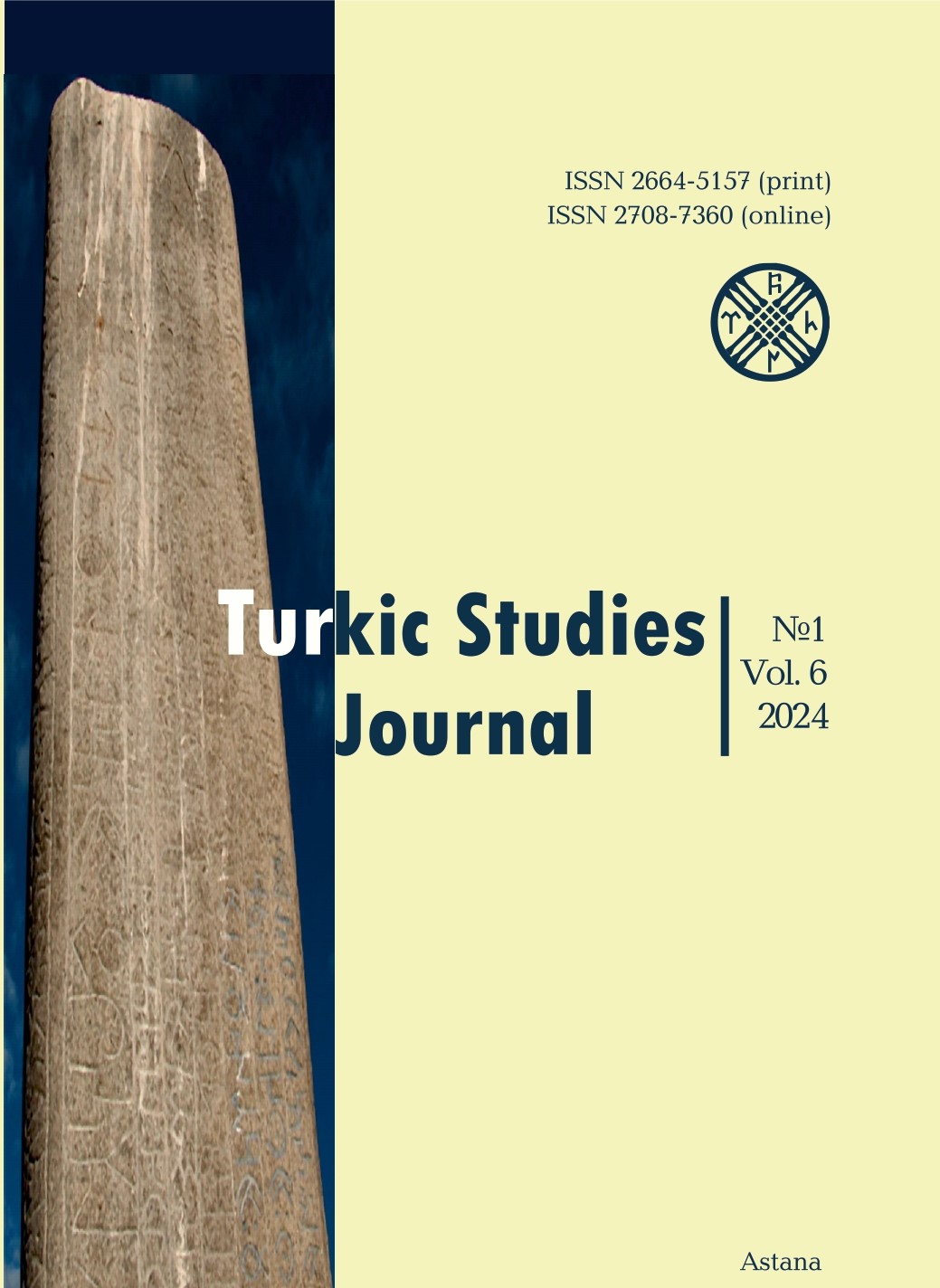
Semantic explications of affixal word formation in the «Yrk Bitig» manuscript
Views: 672 / PDF downloads: 478
DOI:
https://doi.org/10.32523/2664-5157-2024-1-112-134Keywords:
аffixal word formation, the «Yrk Bitig» manuscript, word-formation pair, semantic analysis, producing base, derivative base, word-forming affix, word-formation meaning, types of motivationAbstract
The derivational subsystem of Turkic written monuments of the early Middle Ages in the semantic aspect has been insufficiently studied. The texts of medieval manuscripts show a wide range of word-formation possibilities, including compound bases, paired and affixed word-formation. The ‘Yrk Bitig’ is the only runic monument written on paper. Research has revealed that semantic relations are evident in the word-formation pair in affixal word formation. In word building, it is important to consider both the producing base and the word-formation affix used, taking into account the meaning of the affix. It is important to define the semantic relations between the derived base and the derived word. These relations are revealed through different types of motivations: direct, phraseological and semantically extended. This article analyses the corpus of word-forming affixes of the manuscript, classifying them based on their productivity and non-productivity. It determines their unique word formation meanings based on the system-forming function of the affixes and the preservation of some historical meanings. Direct motivation is common for both productive and non-productive affixes. However, the formation of names with the affix -laɣ/-lӓg/-laq/-lӓk is only phraseologically motivated.
Names with the affixes -lïγ/-lig/-luγ/-lüg/-lïq and -(a)q/-(ӓ)k/-ïq/-ik/-uq/-ük have all three types of motivation.
Downloads
Reference
Aidarov G., 1986. Kone turkі zhazba eskertkіshterіnіn tіlі [The language of ancient Turkic written monuments]. Almaty: Mektep. 182 p. [in Kazakh].
Batmanov I.A., 1959. Yazyk Eniseiskih pamyatnikov drevnetyurkskoj pis’mennosti [Language of the Yenisei monuments of ancient Turkic writing]. Frunze, AN Kirgizskoj SSR. 218 p. [in Russian].
Vinokur G.O., 1959. Zametki po russkomu slovoobrazovaniyu [Notes on Russian word formation]. Izbrannye raboty po russkomu yazyku [Selected works on the Russian language]. Moscow. P. 419-442. [in Russian].
Ganiev F.A., 1982. Obrazovanie slozhnyh slov v tatarskom yazyke [Formation of compound words in the Tatar language]. Moscow: Nauka. 150 p. [in Russian].
Ganiev F.A., 1985. Konversiya v tatarskom yazyke [Conversion in Tatar language]. Kazan’: Tatar. kn. izd-vo. 109 p. [in Russian].
Garipov T.M., 1959. Bashkirskoe imennoe slovoobrazovanie [Bashkir nominal word formation]. Ufa: BF AN SSSR. 223 p. [in Russian].
Garkavec A.N., 2022. Yrқ bіtіg. Drevnetyurkskaya runicheskaya kniga gadanij, X vek. Nabor, transkripciya, perevod, slovar’ [Yrқ bіtіg. Ancient Turkic runic book of fortune telling, 10th century. Typing, transcription, translation, dictionary]. Almaty: Baur. 5 p. [in Russian].
Drevnetyurkskij slovar’ [Ancient Turkic dictionary], 1969. Redaktory: V.M. Nadelyaev, D.M. Nasilov, E.R. Tenishev, A.M. Shcherbak [Editors: V.M. Nadelyaev, D.M. Nasilov, E.R. Tenishev, A.M. Shcherbak]. Leningrad: Izdatel’stvo «Nauka», Leningradskoe otdelenie. 715 p. [in Russian].
Ensegenuly T., 2012. Yrқ bіtіg: Turkі runa zhazuymen қagazga tusіrіlgen filosofiyalyq olender zhinagy [Yrқ bіtіg: A collection of philosophical poems written on paper with Turkic runic script]. Almaty: Toganaj T. [in Kazakh].
Esipova A.V., 2011. Tyurkskoe slovoobrazovanie kak yazykovaya sistema [Turkic word formation as a linguistic system]. Novosibirsk: Izd-vo Sibirskogo otd-niya Rossijskoj akad. nauk. 198 p. [in Russian].
Zhanalina L.K., 1993. Podgotovka uchitelya-bilingva v pedagogicheskom vuze [Training of a bilingual teacher at a pedagogical university]. Almaty: «Ana tіlі». 192 p. [in Russian].
Zhanalina L.K., 2011. Integrativnoe slovoobrazovanie [Integrative word formation]. Almaty: KazNPU im. Abaya. 492 p. [in Russian].
Zholdasbekov M., Karzhaubai S., 2006. Atlas Orhonskih pamyatnikov [Atlas of Orkhon monuments], per. s kaz. M. Zholdasbekova, K. Sartkozhauly, N. Shaimerdinovoi. Astana: Kultegin. 356 p. [in Russian].
Zhumabaeva A.A., 2021. Lingvokul’turologicheskaya kodifikaciya i interpretaciya pamyatnika «Yryk Bitig» [Gadatel’naya Kniga] [Linguocultural codification and interpretation of the monument «Yryk Bitig» Divinatory Book]. Almaty: KazNU im. al’-Farabi. [in Russian].
Zemskaya E.S., 1992. Slovoobrazovanie kak deyatel’nost’ [Word formation as an activity]. Moscow: Nauka. 220 p. [in Russian].
Zemskaya E.S., 1989. Slovoobrazovanie [Word formation]. Sovremennyj russkij yazyk: Ucheb. dlya filol. spec. un-tov. 2-e izd., ispr. i dop. [Modern Russian language: Textbook. for philol. specialist. univ. 2nd ed., rev. and additional]. Moscow: Vyssh. shk. P. 240-244. [in Russian].
Kaidar A.T., 1969. Razvitie sovremennogo ujgurskogo literaturnogo yazyka [Development of the modern Uyghur literary language]. Vol.1. Iss. 1. Alma-Ata: Nauka. 359 p. [in Russian].
Kerimov A.K., 2009. Slovoobrazovatel’nye affiksy v yazyke pamyatnikov tyurkoyazychnoj literatury XIV veka [Word-forming affixes in the language of monuments of Turkic literature of the 14th century]. Almaty. 154 p. [in Russian].
Kononov A.N., 1980. Grammatika yazyka tyurkskih runicheskih pis’mennyh pamyatnikov VII–IX vv [Grammar of the language of Turkic runic written monuments of 5–9 centuries]. Leningrad: Nauka. 255 p. [in Russian].
Kotvich V., 1962. Issledovanie po altajskim yazykam [Research on Altai languages]. Moscow: Izd-vo inostrannoj literatury. 371 p. [in Russian].
Kubryakova E.S., 2004. Yazyk i znanie: Na puti polucheniya znanij o yazyke: Chasti rechi s kognitivnoj tochki zreniya. Rol’ yazyka v poznanii mira. Ros. akademiya nauk. In-t yazykoznaniya [Language and knowledge: Towards acquiring knowledge about language: Parts of speech from a cognitive point of view. The role of language in understanding the world. Ros. Academy of Sciences. Institute of Linguistics]. Moscow: Yazyki slavyanskoj kul’tury. 560 p. [in Russian].
Lopatin V.V., 1970. Grammatika sovremennogo russkogo literaturnogo yazyka [Grammar of the modern Russian literary language]. Moscow. P. 37. [in Russian].
Lopatin V.V., Miloslavskij I.G., Shelyakin M.A., 1989. Sovremennyj russkij yazyk. Teoreticheskij kurs. Slovoobrazovanie. Morfologiya [Modern Russian language. Theoretical course. Word formation. Morphology]. Moscow: Russkij yazyk. 261 p. [in Russian].
Malov S.E., 1951. Pamyatniki drevnetyurkskoj pis’mennosti. Teksty i issledovaniya [Monuments of ancient Turkic writing. Texts and studies]. Moscow-Leningrad: Izdatel’stvo Akademii nauk SSSR. 455 p. [in Russian].
Nadzhip E.N., 1960. Sovremennyj ujgurskij yazyk [Modern Uyghur language]. Moscow: Izdvo vost. lit. 133 p. [in Russian].
Oralbaj N., 2002. Qazaq tіlіnіn sozzhasamy [Word formation of Kazakh language]. Almaty. 190 p. [in Kazakh].
Ramstedt G.I., 1957. Vvedenie v altajskoe yazykoznanie. Per. s nem [Introduction to Altai linguistics. Transl. from germ.]. Moscow. 254 p. [in Russian].
Sevortyan E.V., 1962. Affiksy glagoloobrazovaniya v azerbajdzhanskom yazyke: Opyt sravnitel’nogo issledovaniya [Verb-forming affixes in the Azerbaijani language: Experience of comparative research]. Moscow: Nauka. 643 p. [in Russian].
Sevortyan E.V., 1966. Affiksy imennogo slovoobrazovaniya v azerbajdzhanskom yazyke: Opyt sravnitel’nogo issledovaniya [Affixes of nominal word formation in the Azerbaijani language: Experience of comparative research]. Moscow: Izd-vo vost.lit. 437 p. [in Russian].
Serebrennikov B.A., Gadzhieva N.Z., 1986. Sravnitel’no-istoricheskaya grammatika tyurkskih yazykov. Izdanie 2-e ispravlennoe i dopolnennoe [Comparative-historical grammar of the Turkic languages. 2nd edition corrected and expanded]. Moscow: «Nauka». 301 p. [in Russian].
Serebrennikov B.A., Gadzhieva N.Z., 1986. Sravnitel’no-istoricheskaya grammatika tyurkskih yazykov. Sintaksis [Comparative-historical grammar of the Turkic languages. Syntax]. Moscow: «Nauka». 286 p. [in Russian].
Stebleva I.V., 1984. Drevnyaya tyurkoyazychnaya literatura [Ancient Turkic literature]. Istoriya vsemirnoj literatury. V 9 tomah, t. 2. [History of world literature. In 9 volumes, vol. 2]. Moscow: Nauka. P. 196-204. [in Russian].
Uluhanov I.S., 1980. Russkaya grammatika [Russian grammar]. Moscow. P. 132-133. [in Russian].
Uluhanov I.S., 2012. Slovoobrazovanie. Morfonologiya. Leksikologiya [Word formation. Morphonology. Lexicology]. Moscow: Logos. 600 p. [in Russian].
Habichev M.A., 1971. Karachaevo-balkarskoe imennoe slovoobrazovanie: (Opyt sravnitel’no-istoricheskogo izucheniya) [Karachay-Balkar nominal word formation: (Experience of comparative historical study)]. Cherkessk: Stavrop. kn. izd-vo, Karachaevo-Cherkes. otd-nie. 302 p. [in Russian].
Shaimerdinova N.G., Sandybaeva A.T., 2016. Derivacionnye processy v kazahskom yazyke skvoz’ prizmu slovoobrazovatel’nogo gnezda [Derivational processes in the Kazakh language through the prism of word-formation nest]. Yazyk i mirovaya kul’tura: vzglyad molodyh issledovatelej [Language and world culture: the view of young researchers]. Vol. Part 1. 234 p. [in Russian].
Shaimerdinova N.G., 2022. Kornevaya morfema v drevnetyurkskom yazyke [Root morpheme in ancient Turkic language]. Turkic Studies Journal, 4(1). P. 95–108. https://doi.org/10.32523/2664-5157-2022-1-95-108 [in Russian].
Yanceneckaya M.N., 1979. Semanticheskie voprosy teorii slovoobrazovaniya [Semantic issues of the theory of word formation]. Tomsk: Izd-vo Tomskogo un-ta. 242 p. [in Russian].
Arlotto A. Thomas, 1970-1971. Old Turkic Oracle Books. Monumenta Serica XXIX. P. 685-696.
Bozok E., 2022. Eski Türkçe Fal Metinlerinde Alkiş Ve Kargiş Söylemleri. Milli Folklor, vol. 17, no. 133. P. 71-78. [in Turkish].
Clauson Sir G., 1961. Notes on Irk Bitig. Ural-Altaishche Yahrbüher XXXIII, 3-4. P. 218-225.
Erdal M., 1977. Irk Bitig Üzerine Yeni Notlar [New Notes on Irk Bitig]. Türk Dili Araştırmaları Yıllığı Belleten [Turkish Language Research Yearbook Belleten]. Ankara. P. 63-100. [in Turkish].
Erdal M., 2004. A Grammar of Old Turkic. Leiden Brill. 583 p. Ergin M., 2009. Türk Dil Bilgisi [Turkish Grammar]. İstanbul: Bayrak. 435 p. [in Turkish].https://dsal.uchicago.edu/cgibin/app/hayyim_query.py?qs=&searchhws=yes&matchtype=exact Accessed at: 14.01.2024)
Orkun H.N., 1939. Irk Bitiğ. Orkun H.N. Eski Türk Yazıtları [Ancient Turkish Inscriptions], II. Ankara: TDK. P. 63-103. [in Turkish].
Shaimerdinova N.G., 2022. The word-formation potential of affixes in the ancient Turkic runic texts // Turkic Studies Journal. Vol. 4. No3. P. 118-127. DOI: http://doi.org/10.32523/2664-5157-2022-3-118-127
Tekin T., 1993. Irk Bitig: (the book of omens). Wiesbaden: Harrassowitz. 135 p.Thomsen V., 1912. Dr. M.A. Stein’s Manuscripts in Turkish “Runic” Script from Miran and Tun-Huang. Journal of the Royal Asiatic Society. P. 181-227.
Downloads
Published
How to Cite
Issue
Section
License
Copyright (c) 2024 Turkic Studies Journal

This work is licensed under a Creative Commons Attribution-NonCommercial 4.0 International License.