Reconstruction of the Late Medieval sanctuary in the Burabay forest
Views: 530 / PDF downloads: 523
DOI:
https://doi.org/10.32523/2664-5157-2023-1-60-77Keywords:
Northern Kazakhstan, Burabay, Middle Ages, ritual activity, sanctuary, cultural landscape, traditions and customs, codificationAbstract
The study of the ritual activities of the past, the analysis and historical information extraction from the accumulated material are one of the areas of scientific research in archaeological science. The article presents the results of the study of the Late Medieval sanctuary by the archaeological team of the branch of the Institute of Archeology named after A. Kh. Margulan in 2021. The sanctuary is located on the territory of the Burabay district of the Akmola region, in a forest, on the bank of the dried-up spring. Its location in this natural complex allows to attribute it to sacred objects associated with the veneration
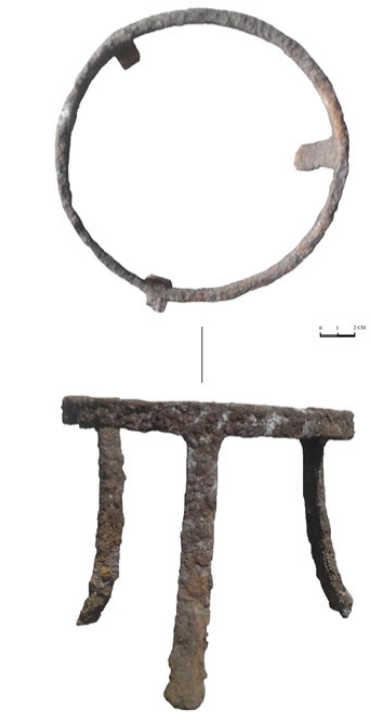
and worship of nature. In the process of examining the religious building as an archaeological object, curious artifacts were discovered – a small clay product of a conical shape and an iron tripod.
In this paper, the authors presented the process of coding and fixing specific ethnic features as a foreign cultural phenomenon surrounded by the autochthonous population and under the influence of Buddhism.
The article presents the results of the study of sacred places, customs and traditions associated with the veneration of spirits as guardians of nature and locality, shows the structural relationship between the elements of the object, revealed during the study of specific rituals and worldview concepts of the inhabitants who left the studied sacred corner. The search for analogies is performed, the information about the degree of study of these archaeological sites is given, and a graphic reconstruction of the sanctuary was carried out. The monument belongs to the late Middle Ages and is a part of the cultural heritage of the country and people.
Downloads
Reference
Adonieva S.B., 2000. Skazochnyy tekst i traditsionnaya kultura [Fairy tale text and traditional culture]. St. Petersburg: Izd-vo Sankt-Peterburgskogo universiteta. 181 р. [in Russian].
Aiyzhy E.V., Bazyrchap A.-Kh.O., 2014. Svyashchennyye mesta tsaatanov v somone Tsagaannuur Khubsugulskogo aymaka Mongolii (po materialam polevykh ekspeditsiy) [Sacred places of the Tsaatans in the Tsagaannuur somon of the Khubsugul aimag of Mongolia (based on field expeditions)]. Vestnik Kalmytskogo instituta gumanitarnykh issledovaniy RAN [Bulletin of the Kalmyk Institute for Humanitarian Research Russian Academy of Sciences], 1. P. 31-35. [in Russian].
Arslanova F.Kh., Charikov A.A., 1974. Kamennyye izvayaniya Verkhnego Priirtyshya [Stone statues of the Upper Irtysh region], Sovetskaya arkheologiya [Soviet archeology], 3. P. 220-235. [in Russian].
Babenkov K.N., 1996. Zhertvenno-pominalnyy kompleks «Aksak». Vozmozhnyye varianty rekonstruktsii [Sacrificial and memorial complex «Aksak». Possible options for reconstruction], Novoye v arkheologii Yuzhnogo Urala [New in the archeology of the Southern Urals]. (Chelyabinsk. P. 245-250). [in Russian].
Baypakov K.M., Voyakin D.A., Yerofeyeva I.V., Kazizov Ye.S., 2018. Ablaykit: vtoroy god kompleksnykh issledovaniy [Ablaikit: the second year of comprehensive research]. Mir Bolshogo Altaya [World of Greater Altai], 3 (4). P. 634-665. [in Russian].
Beysenov A.Z., Kozhakov D.A., 2002. Srednevekovyye pamyatniki Tsentralnogo Kazakhstana [Medieval monuments of Central Kazakhstan]. Istoriya i arkheologiya Semirechya [History and archeology of Semirechye]. (Almaty. P. 150-164). [in Russian].
Botalov S.G., 1996. Kamennyye izvayaniya i zhertvenno-pominalnyye kompleksy Uralo-Ishimskogo mezhdurechya [Stone sculptures and sacrificial memorial complexes of the Ural-Ishim interfluve]. Novoye v arkheologii Yuzhnogo Urala [New in the archeology of the Southern Urals]. (Chelyabinsk. P. 210-244). [in Russian].
Garustovich G.N., Sungatov F.A., 2018. K voprosu o khronologii kultovykh pominalnykh obyektov Yuzhnogo Urala (v sisteme «zhertvenno-pominalnyy kompleks – kamennoye izvayaniye») [On the issue of the chronology of cult memorial objects of the Southern Urals (in the system “sacrificial memorial complex - stone statue”)]. Ufimskiy arkheologicheskiy vestnik [Ufa Archaeological Bulletin], 18. P. 95-107. [in Russian].
Gurkin S.V., 1987. Polovetskiye svyatilishcha s derevyannymi izvayaniyami na Nizhnem Donu [Polovtsian sanctuaries with wooden statues on the Lower Don]. Sovetskaya arkheologiya [Soviet archeology], 4. P. 100-139. [in Russian].
Grigoryev F.P., Ualtayeva A.S., Zheleznyakov B.A., 2018. Tamgalytas i Kayshi – pamyatniki lamaist·skogo kulta v Zhetysu [Tamgalytas and Kaishi - monuments of the lamaist cult in Zhetysu]. Mir Bolshogo Altaya [World of Greater Altai], 3 (4). P. 398-408. [in Russian].
Gomboyev B.Ts., 2006. Kultovyye mesta Barguzinskoy doliny [Cult places of the Barguzinskaya valley]. Moscow-Ulan-Ude. 288 p. [in Russian].
Dmitriyev Ye.A., Zhusupov D.S., 2018. Tyurkskiye ogrady mogilnika Tanabay v kontekste issledovaniy rannesrednevekovykh pamyatnikov Tsentralnogo Kazakhstana [Turkic fences of the Tanabay burial ground in the context of studies of the early medieval monuments of Central Kazakhstan]. Teoriya i praktika arkheologicheskikh issledovaniy [Theory and practice of archaeological research]. (Barnaul. P. 144-154). [in Russian].
Dosymbayeva A.M., 2002. Merke – sakralnaya zemlya tyurkov Zhetysu [Merke - the sacred land of the Turks Zhetysu]. Taraz. 108 p. [in Russian].
Dosımbaeva A., Nusqabay A., 2012. Qumay türktik arxeologïyalıq-étnografïyalıq keşeni [Qumai Turkic archaeological and ethnographic complex]. Astana. 146 p. [in Kazakh].
Yekeyeva E.V., Belekova E.A., 2018. Kultovaya atributika v traditsionnom mirovozzrenii altaytsev [Cult paraphernalia in the traditional worldview of the Altaians]. Gorno-Altaysk. 120 p. [in Russian].
Yermolenko L.N., 2004. Srednevekovyye kamennyye izvayaniya kazakhstanskikh stepey (tipologiya, semantika v aspekte voyennoy ideologii i traditsionnogo mirovozzreniya) [Medieval stone sculptures of the Kazakh steppes (typology, semantics in the aspect of military ideology and traditional worldview)]. Novosibirsk. 132 p. [in Russian].
Kozha M., 2016. Oguzskiye pominalʹnyye khramy [Oguz funeral temples]. Narody i religii Yevrazii [Peoples and religions of Eurasia], 9. P. 85-101. [in Russian].
Kubarev V.D., 1979. Novoye svedeniya o drevnetyurkskikh ogradkakh Vostochnogo Altaya [New information about the ancient Turkic enclosures of the Eastern Altai]. Novoye v arkheologii Sibiri i Dalnego Vostoka [New in the archeology of Siberia and the Far East]. (Novosibirsk. P. 135-161). [in Russian].
Petrov F., 2002. Tyurko-mongolskiye kulty pokloneniya stepnym dukham na territorii Yuzhnogo Zauralya [Turkic-Mongolian cults of worshiping steppe spirits in the Southern Trans-Urals]. Vestnik Chelyabinskogo universiteta. Seriya 10. Vostokovedeniye. Yevraziystvo. Geopolitika [Bulletin of the Chelyabinsk University. Series 10. Oriental studies. Eurasianism. Geopolitics]. 1. P. 85-95. [in Russian].
Sagalayev A.M., 1991. Uralo-Altayskaya mifologiya: simvol i arkhetip [Ural-Altai mythology: symbol and archetype]. Novosibirsk, Nauka: 155 p. [in Russian].
Samashev Z.S., Aytkali A.K., Tolegenov Ye., 2022. K voprosu o sakralizatsii obraza kagana [On the question of the sacralization of the image of the kagan]. Povolzhskaya arheologiya, 2 (40). P. 21-34. [in Russian]. DOI: https://doi.org/10.24852/pa2022.2.40.21.34
Seregin N.N., Shelepova Ye.V., 2015. Tyurkskiye ritualnyye kompleksy Altaya (2-aya polovina I tys. n.e.): sistematizatsiya, analiz, interpretatsiya [urkic ritual complexes of Altai (2nd half of the 1st millennium AD): systematization, analysis, interpretation]. Barnaul: Azbuka. 168 p. [in Russian].
Smakova A., 2016. Pyatiminutnyy putevoditel po uyatam 2016 goda [A five-minute guide to yats in 2016]. 30 noyabrya 2016 g. [Elektronnyy resurs]. Available at: https://esquire.kz/pyatiminutny-putevoditely-po-yatam-2016-goda (Accessed: 06.05.2022). [in Russian].
Suraganova Z.K., Khabdulina M.K., 2021. Po sledam potomkov nebesnoy materi: ot mifa k semantike sakralʹnogo landshafta [In the footsteps of the descendants of the heavenly mother: from myth to the semantics of the sacred landscape]. Stratum plus, 5. P. 99-110. [in Russian].
Khabdulina M.K., 2021. Sakralnyy kod drevnetyurkskogo gorodishcha Bozok (Tsentralnyy Kazakhstan) [Sacred code of the ancient Turkic settlement Bozok (Central Kazakhstan) Ancient Cultures of Mongolia, Southern Siberia and Northern China: Proceedings of the XI International Scientific Conference]. Abakan, September 8-11, 2021. Abakan. P. 230-236. [in Russian].
Kultura naseleniya Turgaya i sopredelnykh territoriy: chelovek i epokha. Srednevekovyj Turgaj: pogrebalnye sooruzheniya, zhertvenno-pogrebalnye kompleksy, predmetnyj mir, 2017. [Culture of the population of Turgai and adjacent territories: man and era. Medieval Turgay: funerary structures, sacrificial and funerary complexes, the objective world]. (Almaty: Institut arkheologii im. A.Kh. Margulana. 360 p.). [in Russian].
Shvetsov M.L., 1979. Polovetskiye svyatilishcha [Polovtsian sanctuaries], Sovetskaya arkheologiya [Soviet archeology], 1. P. 199-209. [in Russian].
Downloads
Published
How to Cite
Issue
Section
License
Copyright (c) 2023 Turkic Studies Journal

This work is licensed under a Creative Commons Attribution-NonCommercial 4.0 International License.