
History of the musical instrument found in the town of Bidayik-Asar (2nd-4th centuries C.E.)
Views: 657 / PDF downloads: 541
DOI:
https://doi.org/10.32523/2664-5157-2024-4-53-71Keywords:
Syr Darya, Aral region, dombra, kossaz, Zhetyasar, shanak, archaeology, keruishAbstract
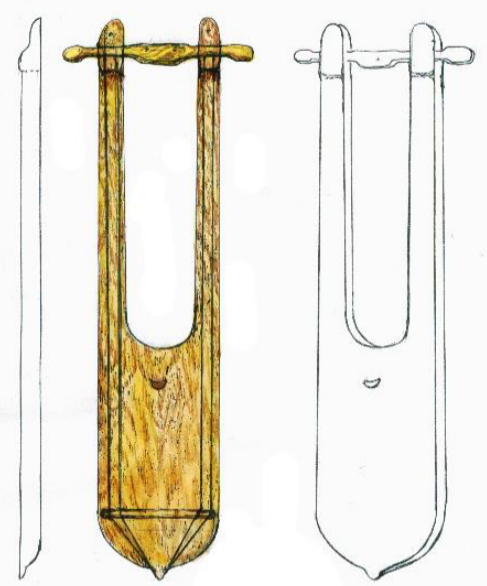
The article examines fragments of wooden musical instruments found by the Horezm Archaeological and Ethnographic Expedition (HAEE) at the Bidayik-Asar monuments associated withthe Zhetyasar culture, which developed in the eastern Aral Sea region. The HAEE began its initial archaeological investigations of the Zhetyasar sites in 1946 with subsequent expeditions in 1948, 1949, and 1951, under the leadership of S.P.Tolstoy. These excavations led to the identification of the ‘Zhetyasar Culture’. These field research continued into the 1970s and 1980s.
Findings from the 1970s–1980s indicate that Bidayik-Asar was inhabited during the first half of the first millennium CE. Based on these dates, the musical instruments found at the site are classified among the earliest known wooden stringed instruments. This discovery, of great scientific interest to music archaeologists, has been categorized into several groups of musical instruments which are currently undergoing detailed study.
The design of the instruments suggests that they may represent early imitations of stringed instruments, crafted from wood.The other part of the bodywork, with opened top and bottom, indicates the existence of different types of musical instruments. Several hypotheses have been proposed to explain their origin and use.
Downloads
Reference
Abugazy M., 2016. Dombıra aspabınıñ şığw tegi jayında [About the origin of the drum instrument] Art portal is a source of information. 20.11.2016 [Electronic resource]. URL: https://www.oner.kz/music/view/588-dombyra-aspabynyng-shygu-tegi-zhajynda (Accessed: 22.04.19). [in Kazakh].
Qashgari М., 1967. «Devonu lugotit turk» [Compendium of the languages of the Turks], Index dictionary. Tashkent. [in Russian].
Jäkişeva Z.S., 2009. Qazaqtıñ dästürli mwzıkalıq aspaptarı [Kazakh traditional musical instruments]. Almatı: «Almatıkitap baspası». 232 p. [in Kazakh].
Jäkişeva Z.S., 2014. Qazaqtıñ aspaptı-mwzıkalıq arxeologïyası [Kazakh instrumental and musical archaeology]. Astana: «Mädenï mura». [in Kazakh].
Kazaqtıñ étnografïyalıq kategorïyalar, uğımdar men atawlarınıñ dästürli jüyesi. Éncïklopedïya [Kazakh traditional system of ethnographic categories, concepts and names. Encyclopedia], 2011. 1 volume. Almaty. 647 p. [in Kazakh].
Kazaqtıñ étnografïyalıq kategorïyalar, uğımdar men atawlarınıñ dästürli jüyesi. Éncïklopedïya [Kazakh traditional system of ethnographic categories, concepts and names. Encyclopedia], 2014. 5 volumes. Almaty. 703 p. [in Kazakh].
Levina L.M., 1971. Keramika nizhney i sredney Syrdar’i v I tys. n.e. [Ceramics of the lower and middle Syr Darya in the 1st millennium AD.]. Tr. Haee. VII. Moscow. 252 p. [in Russian].
Levina L.M., 1996. Etnokülturnaia istoria Vostochnogo Priarälä I tysächeletie do n.e. - I tysächeletie n.e. [Ethnocultural history of the Eastern Aral region I millennium BC.] - I millennium AD. Moscow. 396 p. [in Russian].
Mednikova M.B., 2023. (Otvetstvennyy redaktor) Naseleniye Vostochnogo Priaral’ya v epokhu migratsiy I tysyacheletiya po dannym antropologicheskogo istochnika. Moscow. 226 р. [in Russian].
Meshkeris V.A., 1998. Evolyutsiya, tipologiya i migratsiya strunnykh instrumenntov Sredney Azii VI-IV vekov do n.e. – IV vek n.e. Altay, Khorezm, Vostochnaya parfiya [Evolution, typology and migration of stringed instruments of Central Asia VI-IV centuries BC – IV century AD. Altai, Khorezm, Eastern Parthia] Materialy k entsiklopedii Muzykal’nykh instrumentov Narodov mira Vypusk I. [Materials for the encyclopedia of Musical instruments of the Peoples of the world]. Saint-Petersburg. P. 5-15 [in Russian].
Rudenko S.I., 1953. Kul’tura naseleniya Gornogo Altaya v skifskoye vremya [Culture of the population of the Altai Mountains in the Scythian period]. Moscow-Leningrad. 402 p. [in Russian].
Sadokov R.L., 1970. Muzykal’naya kul’tura drevnego Khorezma [Musical culture of ancient Khorezm]. Moscow. 136 p. [in Russian].
Sadokov R.L., 1971. Tysyacha oskolkov zolotogo saza [Musical culture of ancient Khorezm]. Moscow. Sovetskiy kompozitor. 172 p. [in Russian].
Sarıbaev B., 1981. Qazaqtıñ muzıqalıq aspaptarı [Kazakh musical instruments]. Almatı: Öner. 208 p. [in Kazakh]
Sarıbaev B., 1968. Şerter [Sherter]. Bilim jäne eñbek [Education and work]. No11. [in Kazakh].
Tajekeev A.A., Darmenov R.T., Bilalov S.O., Amirgalina G.T., Sharapova K.A., Sultanzhan Zh.K., 2016. Oñtüstik-Şığıs Aral mañınıñ qala mädenïeti: Jetiasar eskertkişterindegi jaña zerttewler [Urban culture of South-Eastern Aral suburbs: new researches on Zhetiasar monuments]. Proceedings of international scientific-practical conference «Actual issues of historical and cultural heritage of Kazakhstan: past, present and future». Almaty. P. 250-255. [in Kazakh].
Tajekeev A.A., Kurmaniyazov I.S., 2016. Jetiasar mädenïeti eskertkişteriniñ zerttew tarïxı (1946-1971 jj.) [Research history of monuments of Zhetiasar culture (1946-1971)]. Bulletin of KazNU named after Al-Farabi. History Series 4 (83). P. 233-237. [in Kazakh].
Tajekeev A.A., 2019. Bіzdіn dauіrіmіzdіn IV gasyrymen merzіmdeletіn «Qossaz» dombyra [«Kossaz» dombra dated to the IV century of our era]. Proceedings of the International scientific and practical conference «Ancient musical instruments found in archaeological excavations: problems of collection and research». Almaty. P. 34-37. [in Kazakh].
Tazhekeev A.A., Bolelov S.B., Darmenov R.T., Bilalov S.U., 2019. Novyye arkheologicheskiye issledovaniya Zhetyasarskoy kul’tury [New archaeological research of the Zhetyasar culture]. Great Steppe: history and culture. Volume IV. The Great Nomadism: the legacy of the Huns and Sarmatians in things and ideas. Exhibition catalogue. Nur-Sultan. P. 98-104. [in Russian].
Tajekeev A.A., Kurmaniyazov I.S., Kanalkhan E., 2022. [Monuments of Zhetiasar in the works of local historians and cartographic materials of the Russian Empire (late 19th - early 20th century)].
Electronic scientific journal «edu.e-history.kz» No1 (29). Р. 230-242. [in Kazakh]. https://doi.org/10.51943/2710-3994_2022_29_1_230-242
Tolstoy S.P., 1948. Po sledam drevnekhorezmiyskoy tsivilizatsii [In the footsteps of the ancient Khorezmian civilization]. Moscow-Leningrad. 328 p. [in Russian].
Tolstov S.P., 1949. Horezmskaia arheologo-etnograficheskaia ekspedisia AN SSSR v 1948 g. [Khorezm archaeological and ethnographic expedition of the USSR Academy of Sciences in 1948]. News of the USSR Academy of Sciences. History and Philosophy Series. T. 6. no. 3. Moscow. P. 246-247. [in Russian].
Tolstov S.P., 1952. Horezmskaia arheologo-etnograficheskaia ekspedisia AN SSSR (1945-1948 gg.). [Khorezm archaeological and ethnographic expedition of the USSR Academy of Sciences (1945-1948)]. THAE. T. 1. Moscow. P. 14-27. [in Russian].
Kolltveit G., Tazhekeyev А.A., 2023. 4th century stringed musical instrument from Bidayik-asar (Aral region, Kazakhstan). 12th ISGMA-Conference: Artifacts – Images – Texts. Archaeology and the Historiography of Sound University of Wurzburg, 25–29. 9. 2023. (Accessed: 29.09.2023.).
Kolltveit G., 2022. The Sutton Hoo lyre and the music of the Silk Road: anewfind of the fourth century AD reveals the Germanic lyre’s missing eastern connections. Antiquity Vol. 96 (385). P. 208-212.
https://doi.org/10.15184/aqy. 2021. 164.
The musical instrument from Bidayik-asar, Kazakhstan: hypotheses regarding its use and its possible place within the lyre family. News from the Department of Archeology at the University of Cambridge 09.11.2022. [Electronic resource]. https://www.arch.cam.ac.uk/events/asian-archaeology-group/musical-instrument-bidayik-asar-kazakhstan-hypotheses-regarding-its (Accessed: 12.07.2024).
Downloads
Published
How to Cite
Issue
Section
License
Copyright (c) 2024 Turkic Studies Journal

This work is licensed under a Creative Commons Attribution-NonCommercial 4.0 International License.