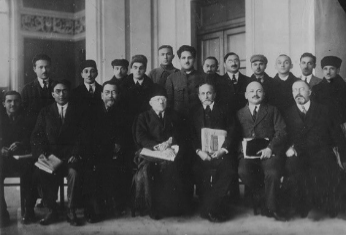
The First All-Union Turkological Congress: repressed and shot executed
Views: 1476 / PDF downloads: 2378
DOI:
https://doi.org/10.32523/2664-5157-2023-2-7-22Keywords:
The First All-Union Turkological Congress, Baku, Azerbaijani alphabet, transition, unified concept of Turkic writing, Arabic script, latinization of writing, Turkic peoples, congress delegates, congress of the repressed and executed.Abstract
In the article we made an attempt to study the primary sources of the history of the First All-Union Turkological Congress, which was held from February 26 to March 5, 1926, in the city of Baku. In this case, we have verbatim reports of the congress, which until recently were inaccessible to a wide range of researchers, relatives and descendants of the participants in that very congress, and we also have a number of other materials regarding participants from the Kyrgyz Autonomous Region within the RSFSR. In fact, it was the first official congress, the main issue of which was the transition from the Arabic script to the Latin alphabet, in all the Turkic republics and peoples of the USSR. Of course, the Azerbaijan SSR was the initiator of the latinization of the writing of the Turkic peoples of the USSR. Unfortunately, many of the current generations of young people of the Turkic-speaking countries and peoples of the CIS, especially among philologists and historians, know practically very little about the First Congress - the Kurultai of Turkologists. Therefore, this article is devoted specifically to the first congress of Turkologists in Baku, which was held almost a hundred years ago. It was the kurultai, which laid the foundation for the new national writing of many Turkic peoples, not only in the USSR, but in other countries of the world. However, this congress remained in history as a congress of repressed and executed delegates, scientists-turkologists, educators and government officials who took part in that famous congress. A vivid proof of this is our materials in this article.
Downloads
Reference
Agzamhodzhaev S., 2020. Dvizhenie progressistov v sozdanii Avtonomnoj Demokraticheskoj Respubliki v Turkestane [Progressional movement for creation Autonomous Democratic Republic of Turkestan]. Turkic Studies Journal No 1, Vol. 2. Nur-Sultan. P. 6-22. [in Russian].
Ашнин Ф.Д., Алпатов В.М., Насилов Д.М., 2002. Репрессированная тюркология. М.: Издательство «Восточная литература» РАН. 294 с. [in Russian]
Bakü Türkoloji Kurultayı (1926): Tutanaklar, 2008. (26 Şubat – 6 Mart 1926)., 2008. (Rusça’dan çevirenler: K.V. Nerimanoğlu, M. Öner). Ankara: TDK Yayınları, 474. [in Turkish]
Dokumenty vneshnej politiki SSSR, 1957. [Documents of the foreign policy of the USSR]. Ch.1 [Part 1]. Moscow., 125 р. [in Russian]
Menzel Th., 1927. Der Türkologische Kongress in Baku. Der Islam. 16, S. 3-4. [In German] DOI: https://doi.org/10.1515/islm.1927.16.1.1
Paporov Yu., 1990. «Beloe solnce pustyni...» Yunost’ [“The white sun of the desert ...” Youth]. No1.P.34-43. [in Russian]
Pervyi Vsesoiuznyi Tiurkologicheskii Sieezd, Obshchestvo Izucheniia i obsledovaniia Azerbaidzhana [First All-Union Turkological Congress. Azerbaijan Research and Survey Society], 1911. Stenographiya Baku – 1926 g. Baku. Izd. «Nagil evi». 552 p. [in Russian].
Pervyi Vsesoiuznyi Tiurkologicheskii Sieezd [First All-Union Turkological Congress], Stenographicheskii otchet [Verbatim report] (26 febralya – 5 marta 1926 g.). Baku. АSSR. 426 р. [in Russian].
Pervyi Vsesoiuznyi Tiurkologicheskii Sieezd [First All-Union Turkological Congress], 2019. / Foreword by G. Mutanov. 2nd ed. Almaty: Kazakh University. 565 p. [in Russian]
Pobeda Velikoj oktyabr’skoj socialisticheskoj revolyucii v Turkestane [The victory of the Great October Socialist Revolution in Turkestan]. 189 p. [in Russian]
Chokai-ogly M., 1935. Turkestan pod vlast’yu Sovetov. K harakteristike diktatury proletariat [Turkestan under the rule of the Soviets. On the characterization of the dictatorship of the proletariat]. Paris: Yash Turkestan. 126 p. [in Russian]
Downloads
Published
How to Cite
Issue
Section
License
Copyright (c) 2023 Turkic Studies Journal

This work is licensed under a Creative Commons Attribution-NonCommercial 4.0 International License.