
Archaeological research on the Kanka fortress city: between nomads and farmers
Views: 862 / PDF downloads: 661
DOI:
https://doi.org/10.32523/2664-5157-2024-2-57-73Keywords:
Tashkent, Kanka, Syrdarya, tempel, mosque, brick, Akhsiket, kitchen room, socio-cultural adaptation, adaptation to the natural environmentAbstract
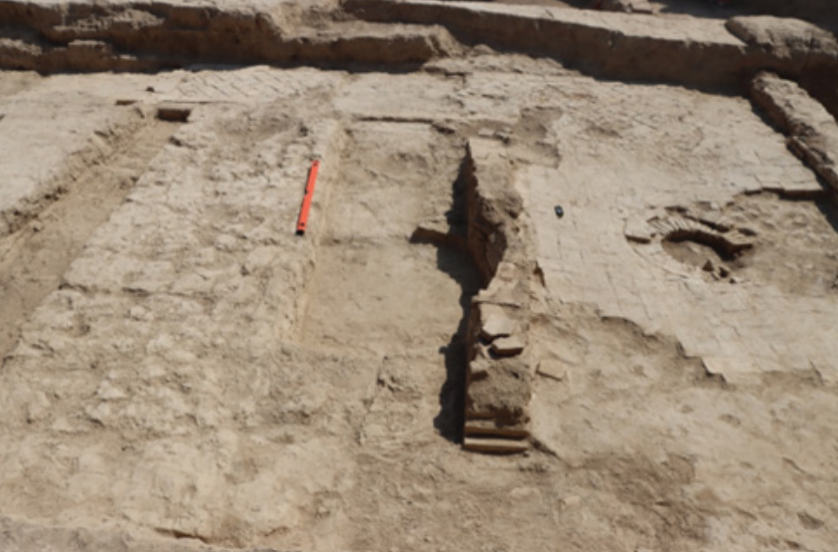
The settlement of Kanka is one of the largest urban centres on the right bank of the Syrdarya. It comprises a citadel, three shakhristans, each surrounded on three sides by defensive walls, and a suburb of rabad. The fourth side of the settlement bordered the riverbank, along which a wall also ran. A significant object, discovered during the excavations of Shakhristan 1 was the city temple, which was a large monumental structure. The core of the temple complex was a square hall surrounded by bypass corridors. The walls of the temple were decorated with paintings and relief moldings. New research in the settlement was conducted on the eastern part of the city temple, the supposed entrance part site of the temple complex. The archaeological excavations at the Kanka monument have yielded insights into the lifestyle of an outpost city situated at the border of the territories of nomads, pastoralists, and farmers in ancient Central Asia. The findings indicate that ancient nomadic populations likely played a significant role in the dissemination of scientific progress. Through their extensive migrations and cultural interactions, they could have served as conduits for exchanging knowledge and technological innovations among disparate regions.
Downloads
Reference
Abdullaev K., 1975. Arheologicheskoe izuchenie gorodishcha Kanka (1969-1972) [Archaeological study of the Kanka settlement (1969-1972)]. IMKU [History of material culture of Uzbekistan]. Issue 12. Tashkent: Fan. P. 128-154. [in Russian].
Abdullaev K.A., 1974. Unikal’naya nahodka terrakotovogo friza [A unique find of a terracotta frieze]. ONU [Social Sciences of Uzbekistan], No2. Tashkent: Fan. P. 45-47. [in Russian].
Anarbayev A., 2013. Ahsiket – stolica drevnej Fergany [Akhsikent is the capital of ancient Fergana]. Tashkent: Tafakkur. 538 p. [in Russian].
Bichurin N.Ya., 1950. Sobranie svedenij o narodah, obitavshih v Srednej Azii v drevnie vremena [Collection of information about the peoples who lived in Central Asia in ancient times]. Volume II. Moscow. 338 p. [in Russian].
Bogomolov G.I., Gendelman P.I., 1990. Metallicheskie izdeliya s gorodishcha Kanka [Metal items from the Kanka settlement]. IMKU [History of material culture of Uzbekistan]. Issue 24. Tashkent: Fan. P. 93-106. [in Russian].
Bogomolov G.I., Gendelman P.I., 1991. Bytovye metallicheskie predmety s gorodishcha Kanka [Household metal objects from the Kanka settlement]. IMKU [History of material culture of Uzbekistan]. Issue 12. Tashkent: Fan. P. 137-148. [in Russian].
Bogomolov G.I., 1995. O hristianstve v Chache [About Christianity in Chacha]. Iz istorii drevnih kul’tov Srednej Azii. Hristianstvo [From the history of the ancient cults of Central Asia. Christianity]. Tashkent: Main Editorial Office of Encyclopedias. P. 71-78. [in Russian].
Bogomolov G.I., Musakaeva A.A., 2020. Klad metallicheskih izdelij i drugie unikal’nye nahodki s gorodishcha Kanka [Treasure of metal items and other unique finds from the Kanka settlement]. Arheologiya Uzbekistana [Archaeology of Uzbekistan]. No. 1 (20). P. 7-16. [in Russian].
Buryakov Y.F., 1975. Istoricheskaya topografiya drevnih gorodov Tashkentskogo oazisa (istoriko-arheologicheskij ocherk Chacha i Ilaka) [Historical topography of the ancient cities of the Tashkent oasis (historical and archaeological sketch of Chach and Ilak)]. Tashkent: Fan. 202 p. [in Russian].
Buryakov Yu.F., Bogomolov G.I., 2009. Kanka [Kanka]. Tashkent. P. 21-25; 69-73; 117-121. [in Russian].
Buryakov Yu.F., 1982. Genezis i etapy razvitiya gorodskoy kulьturы Tashkentskogo oazisa. [Genesis and stages of development of urban culture of the Tashkent oasis]. Tashkent. 212 p. [in Russian].
Gulyamov Y.G., Buryakov Y.F., 1969. Ob arheologicheskih issledovaniyah na gorodishche Afrasiab v 1967-1968 gg. [On Archaeological Research at the Ancient Settlement of Afrasiab in 1967-1968]. In: Gulyamov Ya.G., Afrasiab. Issue.1. Tashkent: Fan P. 268-293. [in Russian].
Dzhurakulov M.D., Krikis Y.K., 1969. Raskopki zdaniya 9-10 vv. na gorodishche Afrasiab [Excavations of the building of the 9th-10th centuries at the ancient settlement of Afrasiab]. In: Gulyamov Ya.G., Afrasiab. Issue 1. Tashkent: Fan. P. 312-316. [in Russian].
Kabanov S.K., 1969. Stratigraficheskij raskop v severnoj chasti gorodishcha Afrasiab. [Stratigraphic excavation in the northern part of the ancient settlement of Afrasiab]. Afrasiab. In: Gulyamov Ya. G., Afrasiab. Issue.2. Tashkent: Fan. P. 16-84. [in Russian].
Kubaev S., 2022. Istoriya kul’tury stroitel’stva zhilyh pomeshchenij na territorii Uzbekistana [History of housing construction culture in Uzbekistan]. Uzbekistan na peresechenii mirovyh civilizacij [Uzbekistan – at the integration of world civilizations]. Tashkent: Baktria Press. P. 117-172. [in Russian].
Kubaev S., 2023. Poyavlenie i razvitie otopitel’nyh sistem na territorii Uzbekistana [The emergence and development of heating systems on the territory of Uzbekistan]. Narody i religii Evrazii [Nations and religions of Eurasia]. Tom 28, No 4. Barnaul. Izd.Аlt.univ. P. 133-141. [in Russian].
Lebedeva T.I., 1986. O samarkandskih taghona [About Samarkand taghona]. Istoriya material’noj kul’tury Uzbekistana. Issue 20. Tashkent: Fan. P. 136-145. [in Russian].
Lebedeva T.I., 1987. Taghona v citadeli Timura [Taghona in Timur’s citadel]. Istoriya material’noj kul’tury Uzbekistana [History of material culture of Uzbekistan]. Issue 21. Tashkent: Fan. P. 151-154. [in Russian].
Shishkina G.V., 1969. Gorodskoj kvartal VIII – nach. XII v. na severo-zapade Afrasiaba [City Quarter 8th – beginning. 12th century in the north-west of Afrasiab]. In: Gulyamov Ya.G., Afrasiab. Issue. 2. Tashkent: Fan. P. 117-156. [in Russian].
Sharakhimov Sh. Sh., 1969. Kvartal goncharov X – nach. XI v. na severo-zapade Afrasiaba [Potters’ Quarter 10th – beginning 11th century in the north-west of Afrasiab] In: Gulyamov Ya.G., Afrasiab. Issue. 2. Tashkent: Fan. P. 224-228. [in Russian].
Amirmasood Nakhaee Sharif, Sanaz Keshavarz Saleh, Sadegh Afzal, Niloofar Shoja Razavi, Mozhdeh Fadaei Nasab and Samireh Kadaei, 2022. Evaluating and Identifying Climatic Design Features in Traditional Iranian Architecture for Energy Saving (Case Study of Residential Architecture in Northwest of Iran). Hindawi. Complexity. Volume 2022, Article ID 3522883, 12 pages https://doi.org/10.1155/2022/3522883
Mahdavinejad M., Javanrudi K., 2012. Assessment of Ancient Fridges: A Sustainable Method to Storage Ice in Hot-Arid Climates. Asian Culture and History. Vol. 4, No. 2; July 2012. https:// doi:10.5539/ach.v4n2p133Pliny, 1947-1958. Natural history. With an English transl. by Rackham. Vol.6. London.
Downloads
Published
How to Cite
Issue
Section
License
Copyright (c) 2024 Turkic Studies Journal

This work is licensed under a Creative Commons Attribution-NonCommercial 4.0 International License.