
Accidental finding of an iron akinak with antenna-shaped pommel
Views: 489 / PDF downloads: 385
DOI:
https://doi.org/10.32523/2664-5157-2023-1-36-48Keywords:
Akinak, pommel, crosshair, iron, melee weapon, armament, accidental finding, typology, early Iron Age, East KazakhstanAbstract
Weapons have been a special-purpose commodity since ancient times; they were bought, kept and taken to the other world. Finding swords, daggers and knives in funerary monuments allows us to trace not only the chronology, but also cultural and ethnic ties in antiquity. But, unfortunately, as practice shows, the weapons are not always found in an undisturbed state and in closed complexes. A large amount of material of this type are so-called accidental findings.
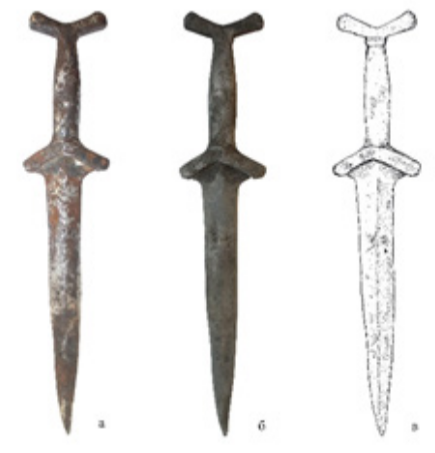
By «accidental findings», the authors mean an archaeological artifact, discovered unintentionally, outside of purposeful searches. Despite the fact that this type of findings was found separately from the monument, and does not give a general understanding of its role in the funeral ritual, the very presence of the akinak on a particular territory is a marker of the distribution area. One of such findings is an akinak with an antenna-shaped pommel and a crosshair broken at a “blunt” angle, which
was found near the village of Marinogorka in the East Kazakhstan region. The purpose of this article is to introduce into scientific circulation the found iron akinak, with all measurements, morphological description, with analogies, and etc. The issue concerning the terminology of the name of this type of blade, as well as its distinctive features (pommel, crosshair, handle) is also considered. The akinak refers to a weapon of the “Prokhorov” type, which was distributed over a large territory and dates no
earlier than the IV-III centuries BC.
Downloads
Reference
Gucalov S.Yu., 2004. Drevnie kochevniki Yuzhnogo Priural’ya VII–I vv. do n.e. [Ancient nomads of the Southern Urals of the 7th-1st centuries BC]. Ural’sk. 136 p. [in Russian].
Denisov A.V., 2012. K voprosu o razmernyh harakteristikah klinkovogo oruzhiya VII-IV vv. do n.e. s territorii Samarskogo povolzh’ya i Yuzhnogo Priural’ya [On the question of the dimensional characteristics of bladed weapons of the 7th-4th centuries BC from the territory of the Samara Volga region and the Southern Urals]. «Kadyrbaevskie chteniya – 2012». Materialy III Mezhdunarodnoj nauchnoj konferencii. Aktobe. P. 154-158. [in Russian].
Ivanov G.E., 1987. Vooruzhenie plemen lesostepnogo Altaya v rannem zheleznom veke [The armament of the tribes of the forest-steppe Altai in the early Iron Age]. Voennoe delo drevnego naseleniya Severnoj Azii. Novosibirsk. 220 p. [in Russian].
Ivanov S.S., 2018. Kinzhaly i mechi rannesarmatskogo oblika s ellipsoidnymi rukoyatyami v Srednej Azii [Daggers and swords of early Sarmatian appearance with ellipsoid handles in Central Asia]. Mir bol’shogo Altaya. No 4 (1). P. 167-176. [in Russian].
Ivanov S.S., 2008. Kinzhaly rannih kochevnikov Semirech’ya i Tyan’-Shanya [Daggers of the early nomads of Semirechye and Tien Shan]. Drevnie i srednevekovye kochevniki Central’noj Azii: sbornik nauchnyh trudov [Ancient and medieval nomads of Central Asia: a collection of scientific papers]/ Otv. red A. A. Tishkin. Barnaul: Azbuka. 256 p. [in Russian].
Kadyrbaev M.K., Kurmankulov Zh. K., 1977. Materialy raskopok mogil’nika Besoba [Materials of the excavations of the Besoba burial ground]. [Arheologicheskie issledovaniya v Otrare Archaeological research in Otrar]. Alma-Ata: Nauka. P. 103-114. [in Russian].
Kozhomberdiev I.K., 1977. Osnovnye etapy istorii kul’tury Ketmen’-Tyube [The main stages of the history of culture of Ketmen-Tyube]. Ketmen’-Tyube: arheologiya i istoriya [Ketmen-Tyube: archeology and history]. Pod. red. V. M. Ploskih, D. F. Vinnika. Frunze: Izd-vo «ILIM». P. 9-24. [in Russian].
Kokorina S.Yu., 2008. Mech, akinak, kinzhal – kakoj termin vybrat’? (k postanovke problemy) [Sword, akinak, dagger - which term to choose? (to problem statement)]. Arheologicheskie vesti. Vyp. 15. Moscow. P. 75-83. [in Russian].
Kocheev V.A., 1995. Dva kinzhala iz Gornogo Altaya [Two daggers from Gorny Altai]. Izvestiya laboratorii arheologii: Mezhvuzovskij sbornik nauchnyh trudov [Proceedings of the laboratory of archeology: Interuniversity collection of scientific papers]. Gorno-Altajsk: Izd-vo GAGU. P. 83-84. [in Russian].
Litvinskij B.A., 2001. Hram Oksa v Baktrii. T.2. Baktrijskoe vooruzhenie v drevnevostochnom i grecheskom kontekste [Temple of Oxus in Bactria. V.2. Bactrian weapons in the ancient Eastern and Greek context]. Moscow: Izd-vo «Vostochnaya literatura». 528 p. [in Russian].
Mamedov A.M., Denisov A.V., 2017. Rannie mechi i kinzhaly Volgo-Ural’skogo regiona s navershiem v vide izognutogo bruska [Early swords and daggers of the Volga-Ural region with a pommel in the form of a curved bar]. Arheologicheskoe nasledie Central’nogo Kazahstana: izuchenie i sohranenie [Archaeological heritage of Central Kazakhstan: study and conservation]. Sbornik nauchnyh statej, posvyashchennyj 70-letiyu organizacii Central’no-Kazahstanskoj arheologicheskoj ekspedicii Akademii nauk Kazahstana [Collection of scientific articles dedicated to the 70th anniversary of the organization of the Central Kazakhstan archaeological expedition of the Academy of Sciences of Kazakhstan]. Almaty: Nauchno-issledovatel’skij centr istorii i arheologii «Begazy-Tasmola». T.2. P. 219-225. [in Russian].
Mel’nikova O.M., 2008. Metodologiya otechestvennoj arheologii: stihiya tradicii ili intuitivnyj poisk obosnovannogo vybora [Methodology of domestic archeology: the element of tradition or an intuitive search for a reasonable choice]. Voprosy arheologii Urala: sbornik nauchnyh trudov [Questions of archeology of the Urals: a collection of scientific papers]. Ekaterinburg: Surgut. Vyp. 25. P. 6-13. [in Russian].
Mogil’nikov V.A., 1997. Naselenie Verhnego Priob’ya v seredine – vtoroj polovine I tysyacheletiya do n. e. [The population of the Upper Ob region in the middle v the second half of the I millennium BC.]. Moscow. 195 p. [in Russian].
Moshkova M.G., 1963. Pamyatniki prohorovskoj kul’tury [Monuments of Prokhorovka culture]. Arheologiya SSSR. Svod arheologicheskih istochnikov. Mоscow. 55 p. [in Russian].
Pogodin L.I., 1998. Vooruzhenie naseleniya Zapadnoj Sibiri rannego zheleznogo veka [Armament of the population of Western Siberia in the early Iron Age]. Omsk: Omsk, gosuniversitet. 84 p. [in Russian].
Sejtkaliev M., 2013. Kinzhaly s volyutoobraznym navershiem v svete migracionnoj koncepcii [Daggers with a volute-shaped pommel in the light of the migration concept]. Vestnik MICAI, Vypusk 17. P. 3-18. [in Russian].
Simonenko A.V., 1984. Sarmatskie mechi i kinzhaly na territorii Severnogo Prichernomor’ya [Sarmatian swords and daggers in the Northern Black Sea region]. Vooruzhenie skifov i sarmatov. Kiev. P. 129-147. [in Russian].
Smirnov K.F., 1961. Vooruzhenie savromatov [Armament of the Savromats]. MIA. No 101. Moscow: AN SSSR. 162 p. [in Russian].
Tairov A.D., Ul’yanov I.V., 1996. Sluchajnye nahodki oruzhiya blizhnego boya iz kollekcii laboratorii arheologicheskih issledovanij Chelyabinskogo universiteta [Accidental finds of melee weapons from the collection of the laboratory of archaeological research of the Chelyabinsk University.]. Materialy po arheologii i etnografii [Materials on archeology and ethnography]. Chelyabinsk. P. 139-147. [in Russian].
Tairov A.D., 2019. Yuzhnyj Ural v epohu rannih kochevnikov [Southern Urals in the era of early nomads]. A.D. Tairov. Istoriya Yuzhnogo Urala: v 8 t. T. 3. Chelyabinsk: Izdatel’skij centr YuUrGU. 400 p. [in Russian].
Frizen O.I., Yablonskij L.T., 2017. Klinkovoe oruzhie rannih kochevnikov Yuzhnogo Priural’ya: kul’turno-hronologichekij aspekt [Blade weapons of the early nomads of the Southern Urals: cultural and chronological aspect]. Istoriya oruzhiya i voennogo dela. No 1 [History of weapons and military affairs. No. 1]. Chast’ 1. Epoha rannego zheleznogo veka [Part 1. The era of the early Iron Age]. UDK 903.22(218) “638”(082). P. 103. [in Russian].
Habdulina M.K., 1994. Stepnoe Priishim’e v epohu rannego zheleza [Steppe Priishimye in the Early Iron Age]. Almaty: Rakurs. 170 p. [in Russian].
Habdulina M.K., 2019. Novoe v izuchenii Tasmolinskoi arkheologicheskoi kultury Saryarki [New data on the study of the Tasmola archaeological culture of Saryarka]. Turkic Studies Journal. No 2 (1). P. 21-33. [in Russian]. DOI: https://doi.org/10.32523/tsj.02-2019/2-3
Downloads
Published
How to Cite
Issue
Section
License
Copyright (c) 2023 Turkic Studies Journal

This work is licensed under a Creative Commons Attribution-NonCommercial 4.0 International License.