Topography and narrative in the ‘Danişmendname’
Views: 238 / PDF downloads: 162
DOI:
https://doi.org/10.32523/2664-5157-2026-2-77-110Keywords:
Ahmed Danişmend, “Danişmendname”, crusades, Selçuks, gazi, epic, 12th century, Anatolia, folklore, oral literature, Tokat, AmasyaAbstract
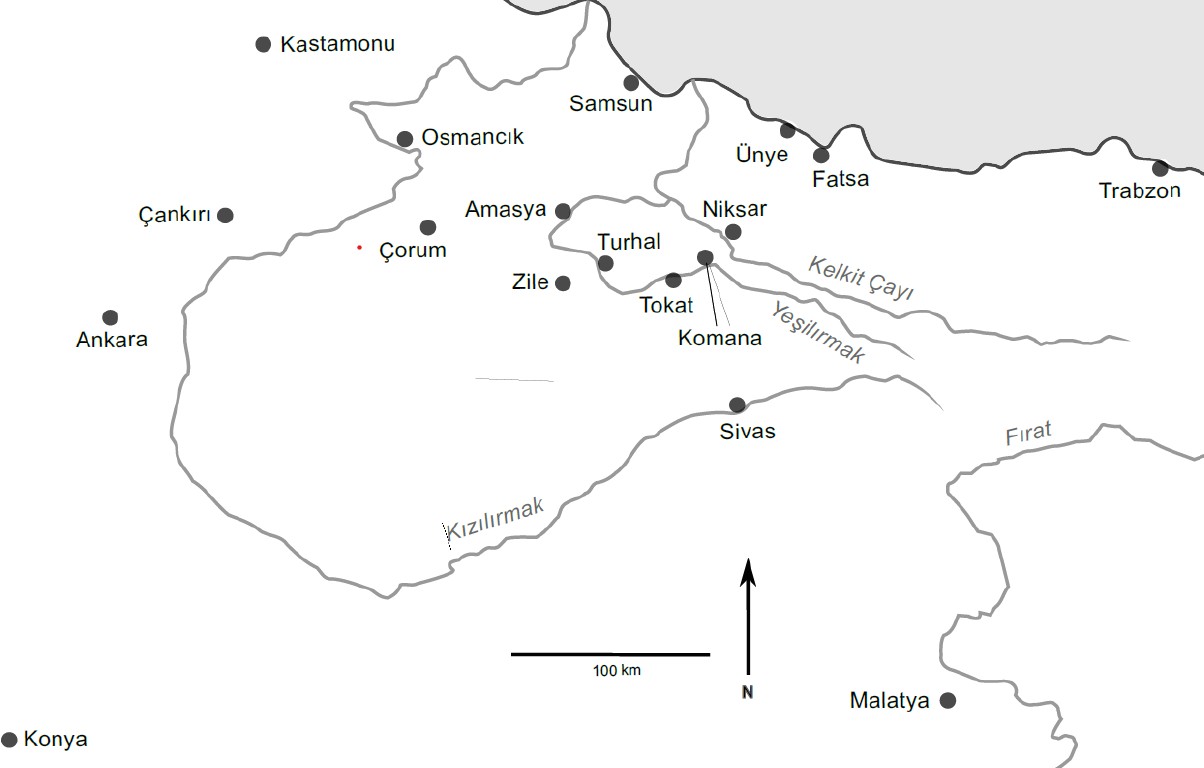
The Danişmendname, “Book of Danişmend”, is one of the oldest preserved epics in the Turkish language and the only one to provide a narrative of events around the turn of the twelfth century, the time of the First Crusade. Its protagonist, Ahmed Danişmend (“the wise”) is a historical figure, but the accounts of his battles against the Byzantines are largely fictional, replete with hyperbole and embellished with loans from other epic traditions, even Christian hagiography. The text was composed about AD 1050 and first written down at the Selçuk court around AD 1175. On this occasion, a fictitious epilogue was added, establishing a link with the Selçuk dynasty. Similarly, a prologue has been added to link the story of Danişmend to that of the epic hero Sayyid Battal. The written version was further expanded and embellished by Arif Ali, governor of Tokat in the fourteenth century, who divided the text into chapters and added verse passages of his own making. Ali’s text formed the basis of all later manuscripts of the “Danişmendname”. Through a detailed case-by-case study of the topographical descriptions in the “Danişmendname”, this study demonstrates that contrary to the opinion of Irène Mélikoff (Irène Mélikoff, 1960), these do not derive from the pen of Arif Ali but formed part of the original composition. Secondly, by applying the concept of the “storyworld” as defined by Buket Kitapçı Bayrı (2020), the study aims to identify the homeland and the mental universe of the original poet. He seems to be familiar with the upper Iris valley around Tokat and Komana as well as the area within the triangle Çorum-Amasya-Turhal. Cankırı and Niksar are also described in terms which may derive from personal observation. The author has a soldier’s eye for the landscape and probably participated in military campaigns on the frontier between Byzantium and Islam. Most of the other cities mentioned in the epic – Malatya, Ankara, Samsun, Osmancık, Sinop, Kastamonu, etc. – are mere names, and there is no attempt at describing their site or appearance. Outside his home region, the author has no clear idea of the geography and consistently underestimates the distance to Malatya or Bagdad. We may conclude that the originator of the “Danişmendname” was a native of northern Anatolia, well versed in the traditions of local storytellers and the topography of his homeland, but with little knowledge or experience of the wider world.
Downloads
Reference
M., 2022. Anadolu’nun XI. - XIII. Yüzyıllar Arasındaki Tarihî Coğrafyası Hakkında Bir Kaynak: Dânişmend Gazi Destanı. Karadeniz Araştırmaları. 19. P. 673-697. https://dergipark.org.tr/tr/pub/karadearas/article/1172203 DOI: https://doi.org/10.56694/karadearas.1172203
Akar A., 2016. Mirkatü’l-Cihad (Cihadın basamakları): Dil İncelemesi, Metin, Dizin. Ankara: Türk Dil Kurumu Yayınları.
Akkaya S., 1957. Kitab-i Melik Danischmend Gazi: Ein türkisch-historischer Heldenroman aus der Mitte des 13. Jahrhunderts. Z.V. Togan (ed.). Proceedings of the Twenty-Second Congress of Orientalists. 2. Leiden: Brill. P. 432-435. DOI: https://doi.org/10.1163/9789004612860_119
Anderson J.C.G., 1900. A Journey of Exploration in Pontus. Bruxelles: Lamartine. https://dn720702.ca.archive.org/0/items/journeyofexplora00ande/journeyofexplora00ande.pdf
Aydoğan Z., 2016. Changing Perceptions along the Frontiers: The Moving Frontier with Rum in Late Medieval Anatolian Frontier Narratives, K. Schull, C. Verhaaren (eds). Living in the Ottoman Realm: Empire and Identity, 13th to 20th Centuries. Bloomington: Indiana University Press. P. 29-41.
Aydoğan Z., 2021, Oral performance and Text: Narrators, Authors, and Editors in the Anatolian Turkish Warrior Epics, L. Rzehak, T. Loy, A. Ahmad, A. Durdu, O. Günther (eds).
The Written and the Spoken in Central Asia: Festschrift for Ingeborg Baldauf. Potsdam: Tethys. P. 405-422.
Başat Ü., 2022. Antakya Haçlı Prinkepsi Bohemond’un Niksar’daki Esareti ve Bunun Kişiliğine Etkileri. Ç. Yılmaz (ed.). 5. Tokat Sempozyumu, 14-15-16 Ekim 2022. Tokat: Tokat Gaziosmanpaşa Üniversitesi. P. 27-41. https://www.scribd.com/document/1002818600/5-Tokat-Sempozyumu-1-Cilt
Bayrı B.K., 2020. Warriors, Martyrs, and Dervishes: Moving Frontiers, Shifting Identities in the Land of Rome (13th-15th Centuries). Leiden: Brill. https://brill.com/display/title/55940 DOI: https://doi.org/10.1163/9789004415843_005
Bekker-Nielsen T., 2021. Evliya Çelebi in Vezirköprü. Cedrus 9. P. 459-472. https://dergipark.org.tr/en/pub/cedrus/article/959455 DOI: https://doi.org/10.13113/CEDRUS.202123
Bekker-Nielsen T., 2023. Textual problems in the Danişmendname. Mediterranean Journal of Humanities 13. P. 59-70. http://proje.akdeniz.edu.tr/mcri/mjh/13/MJH-13-5-Tonnes_BEKKER_NIELSEN.pdf DOI: https://doi.org/10.13114/MJH.2023.593
Bosworth C.E., 2004. The New Islamic Dynasties: A Chronological and Genealogical Manual. Edinburgh: Edinburgh University Press.
A., Winfield D., 1985. The Byzantine monuments and topography of the Pontos. Washington, DC: Dumbarton Oaks Research Library and Collection. https://archive.org/details/bryer-winfield-1985-byz-pontus-01-02/page/n721/mode/2up
Cahen C., 1968. Pre-Ottoman Turkey: a General Survey of the Material and Spiritual Culture and History c. 1071-1330. London: Sidgwick and Jackson.
Çetin C., 2013. Ulak Yol Durak Anadolu Yollarında Padışah Postaları (Menzilhaneler)(1690-1750). Istanbul: Hikmetevi. https://archive.org/details/cemal-cetin-anadolu-yollarindapadisah-postalari-ulak-yol-durak/page/n1/mode/2up
Dedes Y., 1996. Battalname: English Translation, Turkish Transcription, Commentary and Facsimile. 1-2. Cambridge. MA: Department of Near Eastern Languages and Civilizations. Harvard University.
Demir N., 2002. Dānişmend-name: Critical Edition, Turkish Translation, Linguistic
Analysis, Glossary, Facsimile. Cambridge. MA: Department of Near Eastern Languages and Civilizations. Harvard University.
Demir N. 2020. Dānişmendname: Eski Türkiye Türkcesi, Türkiye Türkcesi, Dil incelemesi ve sözlük. Ankara: Atatürk Kültür Merkezi Yayınları.
Erciyas D.B., 2021. Komana’da Bizans’tan Selçuklu’ya Geçişte Kimlik, Nüfus Dinamikleri ve Kırsal Ekonomi. K. Durak, N. Necipoğlu, T. Uyar (eds). Türkiye’de Bizans Çalışmaları: Yeni Araştırmalar, Farklı Eğilimler. Istanbul: Türkiye Bankasi Kültür Yayınları. P. 103-118.
Fleischer C.H., 2016. Bureaucrat and Intellectual in the Ottoman Empire: the historian Mustafa Âli (1541-1600). Princeton. NJ: Princeton University Press.
Galmés de Fuentes A., 1979. Le Charroi de Nîmes et la tradition arabe. Cahiers de civilisation médiévale. 22. P. 125-137. https://www.persee.fr/doc/ccmed_0007-9731_1979_num_22_86_2102 DOI: https://doi.org/10.3406/ccmed.1979.2102
Hamilton W.J., 1842. Researches in Asia Minor, Pontus and Armenia 1-2. London: John Murray. https://archive.org/details/Travel1838HamiltonArm/page/n13/mode/2up
İzmirler Y., 2023. Dânişmendli devleti paraları: The Coins of the Danishmendids. İstanbul: Ege Yayinları.
Karasu Y.E., 2021. Komana Örneği Üzerinden Anadolu Selçuklu Dönemi Kırım Seramik Ticareti ve Usta Göç Hareketliliği. Karadeniz Araştırmaları. 18/71. P. 717-733. https://dergipark.org.tr/en/download/article-file/2277564 DOI: https://doi.org/10.12787/KARAM1744
Köroğlu K., Danişmaz H., 2018. The Origin of Stepped Rock-Cut Tunnels in Eastern Anatolia. Ancient Near Eastern Studies 55. P. 107-124. https://www.academia.edu/36806332/The_Origin_of_Stepped_Rock_Cut_Tunnels_in_Eastern_Anatolia
Kurşun Z., Kahraman S.A., Dağlı Y., 1999. Evliya Çelebi Seyahatnamesi Topkapı Saray
Kütüphanesi Bağdat 304 Numaralı Yazmanın Transkripsiyonu. 2 kitap. Istanbul: Yapı Kredi Yayınları.
Lindahl C., 2012. Singers and Tales in the 21st Century: The Legacies of Milman Parry and Albert Lord. Fabula 52. P. 302–307. https://www.degruyterbrill.com/document/doi/10.1515/fabula-2011-0025/html DOI: https://doi.org/10.1515/fabula-2011-0025
Mélikoff I., 1960. La geste de Melik Dānişmend: Étude critique du Dānişmendname, 1-2. Paris: Institut Français d’Archéologie d’Istanbul. https://archive.org/details/melikoff1960danishmendname
Meulder M., 2013. Le ”cheval de Troie” sous une autre forme. Le guerrier déguisé en marchand: exemples antiques et médiévaux. Nouvelle Mythologie Comparée. 1. P. 1-42. https://www.academia.edu/86881069
Meulder M., 2014. Le stratagème normand de l’homme mort pour s’emparer d’une place forte a-t-il une origine indo-européenne? Classica et Mediaevalia 64. P. 287-366.
Mordtmann A.D., 1876. Die Dynastie der Danischmende. Zeitschrift der Deutschen Morgenländischen Gesellschaft. 30. P. 467–486. https://www.jstor.org/stable/i40131977
Oikonomidès N., 1983. Les Danishmendides, entre Byzance, Bagdad et le sultanat d’Iconium. Revue Numismatique. Series 6. 25. P. 189-207. https://www.persee.fr/doc/numi_0484-8942_1983_num_6_25_1843 DOI: https://doi.org/10.3406/numi.1983.1843
Purton P., 2010. A History of the Early Medieval Siege: c. 450-1200. Martlesham: Boydell& Brewer. Reichl K., 2000. Singing the Past: Turkic and Medieval Heroic Poetry, 2nd edition. Ithaca, NY: Cornell University Press. https://muse.jhu.edu/book/65032
Sökmen E., 2009. Characteristics of the Temple States in Pontos, J.M. Højte (ed.), Mithradates VI and the Pontic Kingdom. Aarhus: Aarhus University Press. P. 277-288. https://antikmuseet.au.dk/fileadmin/www.antikmuseet.au.dk/Pontosfiler/BSS_9/BSS9_16_sokmen.pdf DOI: https://doi.org/10.2307/jj.35529233.19
Downloads
Published
How to Cite
Issue
Section
License
Copyright (c) 2026 T. Беккер-Нильсен

This work is licensed under a Creative Commons Attribution-NonCommercial 4.0 International License.