Translation and scholarly commentary on the Old Uyghur script copy of Latafat-nama (the Otrar library collection)
Views: 278 / PDF downloads: 131
DOI:
https://doi.org/10.32523/2664-5157-2026-2SI-143-155Keywords:
‘Latafatnama’, Khojandi, Old Uyghur manuscript, Turkic studies, translation, Turkic literature, love poetry, medieval literature, transcriptionAbstract
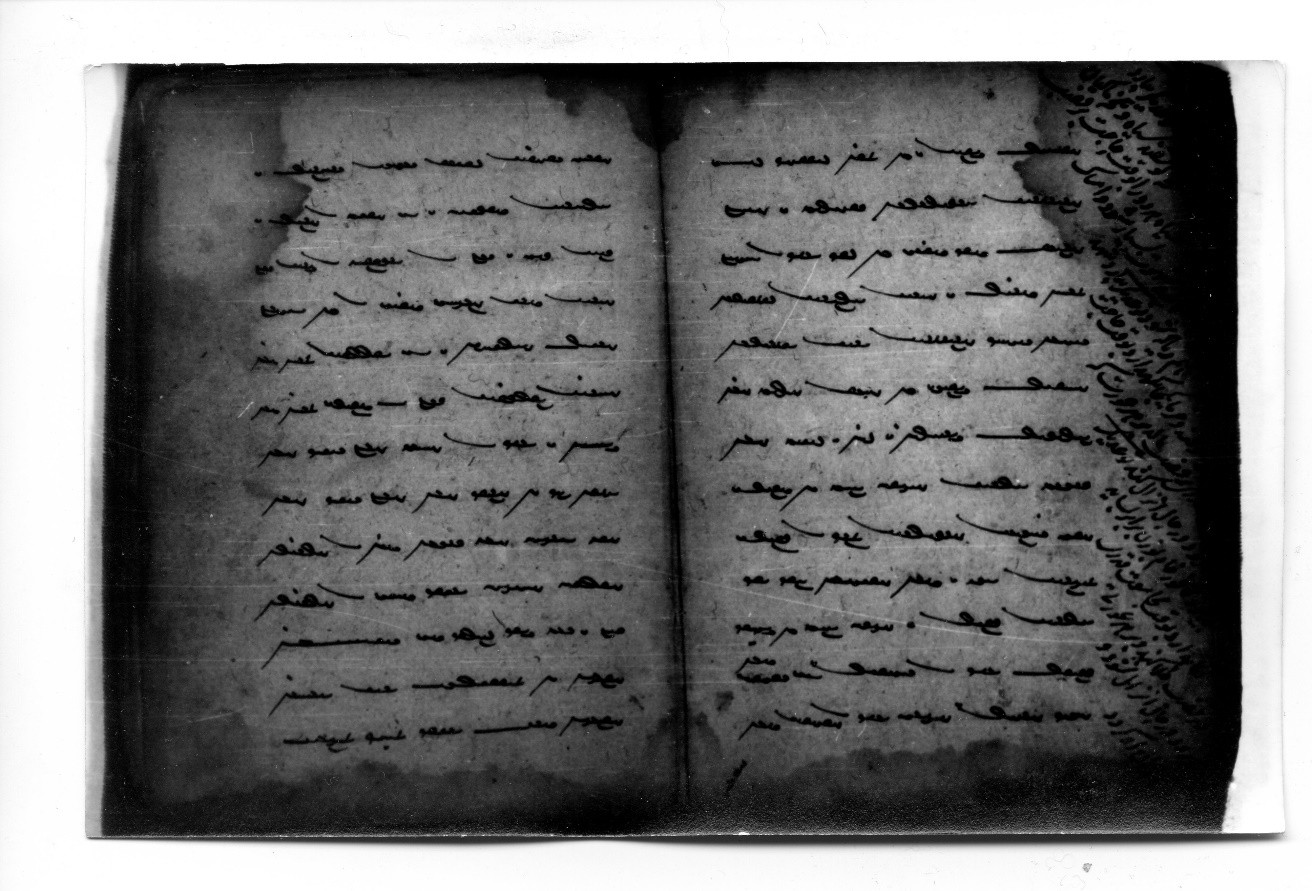
The Kabul copy of Latāfatnāma by Khodjandi, written in the Old Uyghur script, is preserved in the Otrar Library Collection of L.N. Gumilyov Eurasian National University. The manuscript consists of 56 folios and 313 lines. In stylistic terms, Latāfatnāma is closely related to Khwarazmi’s Mahabbatnāma and Yusuf Emri’s Dakh-nāma, composed within the same literary tradition. However, the text is distinguished by its relative linguistic conservatism and is of particular significance as a source reflecting linguistic features characteristic of the Karakhanid period. The language of 11th century Turkic written monuments, particularly those of the Karakhanid era, subsequently underwent substantial structural changes. Although the literary school of this period eventually declined, its poetic conventions continued to be preserved for centuries. At the time of the composition of Latāfatnāma, a common literary koine was in use, incorporating local dialectal features and enjoying broader circulation than earlier literary varieties. Its dialectal basis differs from that reflected in Kutadgu Bilig and Atabat al-Haqāyiq. The present study demonstrates that the language most closely related to that of Latāfatnāma is Khwarazmian Turkic; accordingly, this linguistic variety was used as the principal reference point for the transcription of the text. Since this work had not previously been translated into Kazakh, the aim of the study was to produce a translation of the Kabul version, provide scholarly commentary, and introduce the text into academic circulation. The study also includes a review of the history of research on the work and an examination of historical figures associated with it, along with several original interpretative observations. In preparing the transcription of the original text, particular attention was paid to the limited graphemic inventory of the Old Uyghur script, in which phonemic distinctions such as a/e, o/u, y/i, k/g, and b/p are represented by single graphemes. The transcription was conducted with careful consideration of the linguistic features of Khwarazmian Turkic. An analysis of the verse Tabīʿatdın çıḳardım naẓm bisyār / acunda bulmadım ikev ḫarīdār (“I composed many poems expressing my nature, yet found not even two recipients in this world”) suggests the possible existence of additional works by Khodjandi. During the translation process, individual lexical items were supplemented with scholarly commentary and interpreted on the basis of lexicographic sources. A structural analysis of the text identified its compositional organization, consisting of an introduction, ten main chapters, and a conclusion. Throughout the translation, the semantic structure of the original was preserved, while explicative and descriptive translation techniques were employed where necessary.
Downloads
Reference
Moldabay T., 2013. «Oty`rar kіtapxanasy`» gy`ly`mi-zertteu ortaly`gy`ndagy` alfavitіmen zhazy`lgan «Latafatnama»-ga gy`ly`mi tusіnіkteme [Scientific commentary on the "Latafatnama" written in the alphabet of the "Otyrar Library" research center]. “Habarshy” L.N. Gumilev aty`ndagy` EUU-nіn Haly`qaraly`q qaty`nastar fakul`tetіnіn gy`ly`mi zhurnaly`["Khabarshy" is a scientific journal of the Faculty of International Relations of the L.N. Gumilyov Eurasian National University]. №1-2 sany`. P. 82-87. [in Kazakh].
Samojlovich A.N., 1934. Iranskij geroicheskij e`pos v literaturax tyurkskix narodov Srednej Azii. v kn. Ferdovsi [The Iranian Heroic Epic in the Literatures of the Turkic Peoples of Central Asia]. L., 161 р. [in Russian].
Xodzhandi, 1976. Latafat-name: kniga o krasote. Avt. predisl., per. E`.I. Fazy`lov [Latafat-nameh: A Book about Beauty. Author's preface, translated by E.I. Fazylov]. Tashkent: Fan. 197 р. [in Russian].
Xorezmi, 1961. Muxabbat-name. Izdanie teksta, transkripciya, pere vod i issledovanie E`. N. Nadzhipa [Mukhabbat-nameh. Edition of the text, transcription, translation, and study by E.N. Nadjip]. M. 266 р. [in Russian].
Shherbak A., 1971. Zamechanija o tekste i jazyke Ta'ashshuk-name. [Notes on the Text and Language of Ta'ashshuk-nameh]. «Studia Turcica». Ed. L. Ligeti. Budapest. Р. 431-444. [in Russian].
Bodrogligeti A. J. E., 1980. Fazylov’s Edition of Khujandi’s Latafat-nama: A Review Article. Journal of Middle East Studies. №12. Cambridge University Press. P. 101-109.
Bodrogligeti A., 1972. The Fragments of the Cavahiru'l-asrar. CAJ. V. XVI. № 4. Р. 290-303.
Clauson Sir G., 1928. A Hithero Unknown Turkish Manuscript in «Uighur» Characters. JRAS. № 4. P. 99-130.
Clauson Sir G., 1972. An Etymological Dictionary of Pre Thirteenth-Century Turkish. Oxford University Press. London. 988 p.
Eckmann J., 1988. Çağatayca El Kitabı: haz. KARAAĞAÇ Günay. [Chagatai Language Handbook: compiled by Günay Karaağaç]. İstanbul: Edebiyat Fakültesi Basımevi. 298 р. [in Turkish].
Gandjei T., 2001. Bir Edebi Eserin Yaratılışı ve Tavsifi: Dehname ‘On Aşk Mektubu. çev. Sertkaya A. [The Creation and Description of a Literary Work: Dehname ‘Ten Love Letters’. Translated by A. Sertkaya]. İlmî Araştırmalar: Dil, Edebiyat, Tarih İncelemeleri. [Scholarly Research: Language, Literature, History Studies]. S. 11. Р. 167-174. [in Turkish].
Kaçalin M. S., Ölmez M., 2019. Dîvânu Lugâti't-Turk – Mahmûd el-Kâşgarî. Istanbul: Kabalci Yayınevi. 624 р. [in Turkish].
Riеu С., 1888. Catalogue of the Turkish Manuscripts in the British Museum. London. 287 p.
Sertkaya O.F.,1971. Hocendî’nin Letâfetnâme’si ve Uygur Harfli Nüshasının Tıpkıbasımı [A Facsimile of Hocendî's Letâfetnâme and its Manuscript in Uyghur Script]. TÜDED. C. 19. Р. 232-235. [in Turkish].
Üzeyir A., 2020. Hucandi, Letâfet-nâme. On aşk mektubu. [Hucandi, Letâfet-nâme. Ten love letters]. Ankara: Sonçağ. 188 р. [in Turkish].
Zülfe Ö., 2011. Şiirin İzinde Sözün Gölgesinde. [In the Footsteps of Poetry, in the Shadow of Words]. İstanbul: Bilge Kültür Sanat. 256 р. [in Turkish].
Downloads
Published
How to Cite
Issue
Section
License
Copyright (c) 2026 Т. Молдабай

This work is licensed under a Creative Commons Attribution-NonCommercial 4.0 International License.