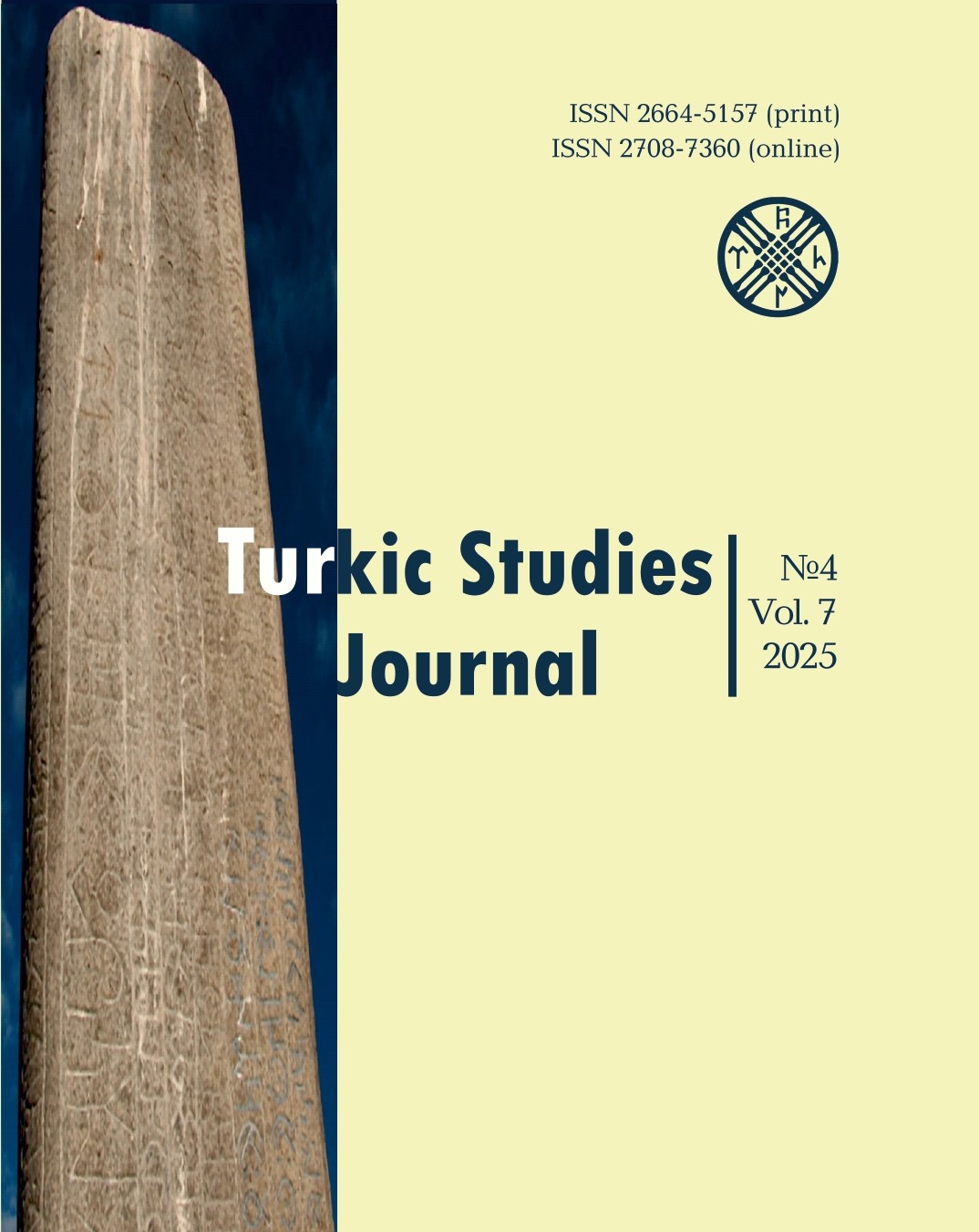
Yolyg Tegin, Alp Eletmish and Tonyukuk – the first historians of the Second Turkic Khaganate
Views: 732 / PDF downloads: 243
DOI:
https://doi.org/10.32523/2664-5157-2025-4-118-130Keywords:
Kül Tegin, Alp Eletmish, Tonyukuk, historian, monuments, Turks, historiography, ideology, view, chronologyAbstract
In Turkic historiography, the authors of the ancient Turkic runic inscriptions – Yolyg Tegin (Kül Tegin), Alp Eletmish (Bilge kagan, Kutlug Elteris) and Tonyukuk – have not yet been widely recognized as historians. The conducted studies have shown that the content and nature of the inscriptions on the Orkhon monuments have a historiographical character. Therefore, the author of the article proposes to consider Iolyg Tegin, Alp Elitmish, and Tonyukuk who described the political and ethnic history of the Second Turkic Khaganate as the first representatives of Turkic historiography. The article analyzes the ideological positions of the supreme rulers of the Second Turkic Khaganate, as well as those of the authors of the mentioned texts, regarding the events they describe. These positions were determined not only by the struggle of the ancient Turks against the Chinese Empire, the Arab Caliphate, and Sogdiana, but also by internal inter-tribal conflicts and cultural traditions. The historians of the Second Turkic Khaganate, in the texts of the Orkhon monuments, call on the Turkicpeoples to preserve the independence of their state and their ethnic culture through the state ideology of “Mangi El (Eternal Nation)”. These views have been proven to be more objective and reliable than those of Soviet-era historians and Chinese chroniclers. It is clear that the medieval Turks' view that their highest mission was to create their own civilization in the Great Steppe shaped their position. Their views are proven to be characterized by objectivity and reliability compared to those of Soviet era historians and Chinese chroniclers. Turkic historians employed several types of historical and chronological methods to determine the timing of events, in particular the 12-year cyclic calendar based on animal names. They also introduced a method of determining the time of an event based on a person's age. To avoid chronological ambiguity, two methods of determining time were used in parallel, meaning that both a person's age and the 12-year animal cycle. Another type of chronology was also applied, whereby the time of an event was determined by the reign period of the khagans' ancestors. The objective and reliable assessment of historical processes and events by Kül Tegin, Alp Eletmish, andTonyukuk – together with their use of several chronological and historical methods – demonstrates that they should be regarded as full-fledged historians of their era. Consequently, they deserve recognition as among the earliest representatives of Turkic historiography. At the same time, the worldview of these first historians of the Second Turkic Khaganate, along with the historical and methodological approaches reflected in their creative tradition and their ideological principles, shows that they were not inferior to the intellectual level of world civilizations of that period and, in some respects, even surpassed it. Therefore, they should be considered the earliest representatives of medieval Turkic historiography as a whole.
Downloads
Reference
Bezertinov R.N., 2006. Drevnetyurkskoe mirovozzrenie. Tengrianstvo [Ancient Turkic worldview. Tengrianism]. Kazan': RIC. «Shkola». 164 p. [in Russian].
Bernshtam A.N., 1946. Social'no - ekonomicheskij stroj orhono-enisejskih tyurok. VІ-VІІІ vv [Social and economic structure of the Orkhon-Yenisei Turks. VІ-VІІІ centuries]. M-L.: Izd. Izd.AN SSSR. 208 p. [in Russian].
Bichurin N.Ya., 1950. Sobranie svedenij o narodah, obitavshih v Srednej Azii v drevnie vremena [Collection of information about the peoples who inhabited Central Asia in ancient times]. Moscow-Leningrad. Vol. 1. [in Russian].
Bіlge қagan bіtіktasynyn ІІІ - qaptalyndagy matіnі. Qazaqstan tarihy turaly turkі derektemelerі [The text of the III-side of the Bilge Kagan inscription. Turkic sources on the history of Kazakhstan], 2005. Volume II. Almaty: Dajk-Press. 252 p. [in Kazakh].
Vasiliev V.P. Kitajskie nadpisi v orhonskih pamyatnikah v Koshocajdame i Karabalgasune [Chinese inscriptions in the Orkhon monuments in Koshhotsaydam and Karabalgasun]. Sbornik trudov Orhonskoj ekspedicii [Collection of works of the Orkhon expedition]. St. Petersburg: 1897. Vol. III. Pp. 1-36 + table. [in Russian].
Grumm-Grzhimajlo G.E., 1926. Zapadnaya Mongoliya i Uryanhajskij kraj [Western Mongolia and the Uryankhai region]. L. Vol.2.VI. 896 p. [in Russian].
Gumilev L.N., 1993. Drevnie tyurki [Ancient Turks]. Moscow: Tovarishchestvo «Klyshnikov, Komarov i K». 501 p. [in Russian].
El-Etmіsh Bіlge qagannyn ekіnshі (Tariat. Terh) bіtіktasynyn matіnі. Qazaqstan tarihy turaly turkі derektemelerі [The text of the second (Tariat. Terkh) inscription of El-Etmish Bilge Khagan. Turkic sources on the history of Kazakhstan], 2005. Vol. ІІ. Almaty: Dajk-Press. 252 p. [in Kazakh].
Klyashtornyj S.G., Sultanov T.I., 1992. Kazahstan letopis' trekh tysyacheletij [Kazakhstan: A Chronicle of Three Millennia]. Alma-Ata: «Rauan». 374 p. [in Russian].
Klyashtornyj S.G., 2011. Drevnetyurkskie runicheskie pamyatniki i ih avtory. Tyurkskij mir: istoriya i sovremennost'. Sbornik statej mezhdunarodnogo tyurkologicheskogo simpoziuma [Ancient Turkic Runic Monuments and Their Authors. The Turkic World: History and Modernity. Collection of Articles from the International Turkological Symposium]. Astana: ENU. P. 18-22. [in Russian].
Kozmin N.N., 1934. Klassovoe lico atlysy Iolyg Tegina, avtora orhonskih pamyatnikov. S.F. Ol'denburgu [Class face rider Iolyg Tegina, author of Orkhonskih pamkanetov. S.F. Oldenburg]. K pyatidesyatiletiyu nauchno-obshchestvennoj deyatel'nosti. 1882-1932. Sb.st. otv. Red.I.Yu. Krachkovskij. L: Izd.AN SSSR. P. 259-277. [in Russian].
Kultegіn bіtіktasynyn 1 betіndegі matіnі. Qazaqstan tarihy turaly turkі derektemelerі [Text from page 1 of the Kultegin inscription. Turkic sources on the history of Kazakhstan], 2005. ІІ -tom. Almaty: Dajk-Press. 252 p. [in Kazakh].
Sartqozha Q., 2003. Orhon muralary.1 kіtap [Orkhon Heritage. Book 1]. Astana. 392 p. [in Kazakh].
Syzdykov S.M., 2020. Al Farabi zhane «Mangіlіk El» ideyasy. (ush tіlde: kazakh, orys, agylshyn) [Al-Farabi and the idea of "Eternal Nation". (in three languages: Kazakh, Russian, English)]. Monograph. Astana: Foliant. 400 p. [in Kazakh, Russian, English].
Tonykok bіtіktasynyn matіnі. Qazaqstan tarihy turaly turkі derektemelerі [The text of the Tonykok inscription. Turkic sources on the history of Kazakhstan], 2005. Vol. ІІ. Almaty: Dajk-Press. 252 p. [in Kazakh].
Downloads
Published
How to Cite
Issue
Section
License
Copyright (c) 2025 Turkic Studies Journal

This work is licensed under a Creative Commons Attribution-NonCommercial 4.0 International License.