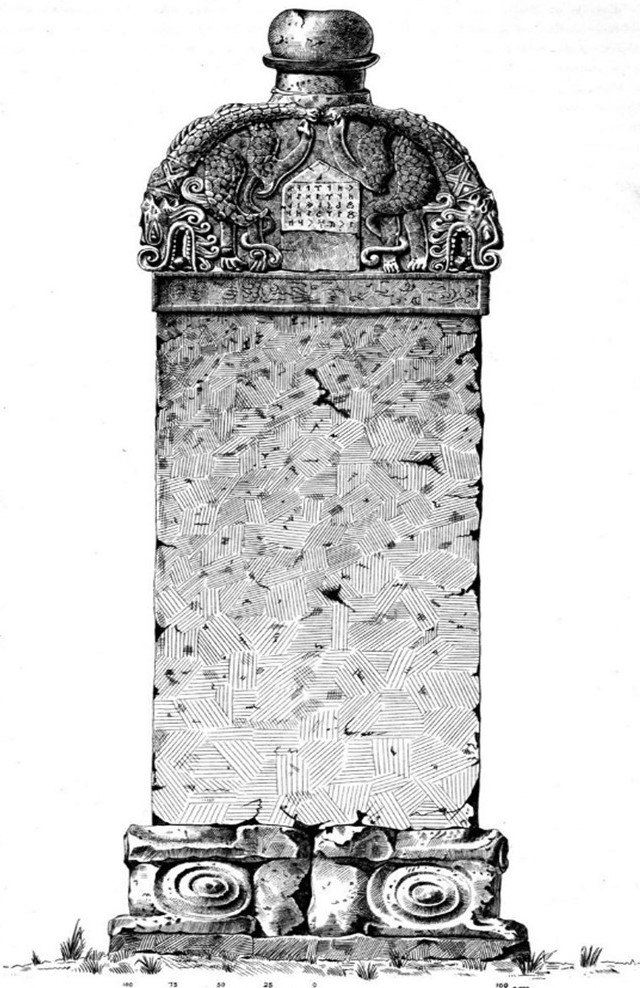
The Chinese text of the medieval "Orda Balik Inscription"
Views: 923 / PDF downloads: 625
DOI:
https://doi.org/10.32523/2664-5157-2025-4-147-169Keywords:
Ancient Turks, Toghyz-Oghyz, Orda-Balyk Inscription, history of research, sources, text in Chinese, history of the Uyghur Khaganate, Khagans, connection with the Tang dynasty, Manichaeism, historical names and conceptsAbstract
The Orkhon River basin in Central Mongolia is known as the "golden cradle" of Turkic statehood and was the center of the ancient Turks’ material and spiritual culture. This is confirmed by the Orda-Balyk Inscription, written during the era of the Old Uyghur Empire in Old Turkic, Chinese, and Sogdian. The monument currently has several names: The most common is the Karabalgasun Inscription, followed by the Monument to Togyz Uyghur Bilge Khagan (in whose honor the monument was erected), and Orda-Balyk Inscription (the name refers to its location). Chinese sources refer to the monument is referred to as the "Monument to Ai-Tengirde Kutbolmysh Alyp Bilge Khagan" (九姓回鶻愛登裏羅汩沒蜜施合毗伽可汗聖文神武碑). The first information about the monument was received in the 13th century from the Persian traveler Ata-Malik Juvayni, who traveled to the capital of the Mongol Empire, Karakorum. Then, in the late 19th century, further information about the trilingual monument was obtained through the expeditions of N. Yadrintsev, A. Geikel, and V. Radlov. Subsequently, G. Schlegel, examined the materials from these expeditions, studied the Chinese text and published a translation. Having reviewed previous studies and relying on the Chinese sources Ju Tangshu and Xin Tangshu, the author analyzes the monument's Chinese text, examines its fragments, divided into several parts, provides an interpretation and identifies the monument's dedicatory address, and also reveals the activities of the khagans and the history of the Uyghur state, as captured in the monument's text. Dating back to the 8th century, the Orda-Balyk Inscription, was erected during the era of the spread of Manichaeism among the ancient Turks. The text recounts how the Turkic Bogu Khagan, who had come to help suppress a military rebellion in the Tang Dynasty's interior domains, met two Manichaean missionaries in Luoyang and converted to Manichaeism under their influence. The ruler also ordered for the further spread of Manichaeism among the Orkhon Turks. According to the author, this became the cause of religious conflicts within the state and ultimately leading to the fall of the Uyghur Khaganate. In the article, the author proposes referring to the Uyghur Khaganate as either the United Turkic Khaganate or the Third Turkic Khaganate. This argument is based on the fact that the polity was founded in 745 by the same ancient Turks and demonstrated political, cultural, and ethnic continuity with the Second Turkic Khaganate. In 840, the Uyghur Khaganate disintegrated under the pressure of internal and external factors. The Oghuz and Turks migrated in three directions. Most of them crossed the Altai and Tarbagatai mountains and reached Semirechye, where they intermingled with the local population and participated in the formation of the Karakhanid state.
Downloads
Reference
Barthold V.V., 1964. K voprosu ob yazykakh sogdiyskom i tokharskom [Questions about Sogdian and Tokhar languages]. Coch., T. II, part 2. M. P. 461-470. [in Russian].
Bolin S.L., 1960. Svedeniya arabskikh stochnikov IX-XVI vv. o doline reki Talas i smezhnykh rayonakh [Information from Arab sources of the 9th-16th centuries o the Talas River valley and adjacent areas]. TIIAE AN Kazakh SSR, T VIII. P. 83. [in Russian].
Chavanese E., Pelio P., 1958. Mó ní jiào liúxíng zhōngguó kǎo (féngchéngjūn yì) [A Study of the Popularity of Manichaeism in China (Translated by Feng Chengjun)] xīyù nánhǎi shǐ dì kǎozhèng yì cóng bā biān [A Collection of Translations on the History and Geography of the Western Regions and the South China Sea (Volume 8).]. Běijīng: Zhōnghuá shūjú. 62 p. [in Chinese].
Chen Sulo, 1978. Shì hànwén jiǔ xìng huíhú pí jiā kè hàn bēi xià guān huíhú hé táng cháo de guānxì [Reflections on the relationship between the Uyghurs and the Tang dynasty in the monument of Togyz Oghuz Bilge Khagan]. Zhōngyāng mínzú xuéyuàn xuébào [Journal of Central University for Nationalities]. Beijing, No. 2. P. 11-21. [in Chinese].
Cíhǎi, 1979. Cíhǎi (suōyìn běn) [Cihai (abridged edition)]. Shanghai. 2214 p. [in Chinese].Gen Shimin, 2003. Wéiwú'ěr gǔdài wénxiàn yánjiū [ Research on the ancient literary and historical heritage of the Uyghurs]. Beijing. 546 p. [in Chinese].
Jizhi-Tongjian, 1963. Jizhi-Tongjian [Mirror of state governance], Volume 237. Hu Sansheng zhuwen [Annotations by Hu Sansheng]. Zhonghua Shuju. Beijing, 7638 p. [in Chinese].
Kayrken T.Z., 2022. Kultegin eskertkishi. Tarihiy-derektanulyq taldau [Kultegin monument. Historical-data analysis]. Astana. 262 p. [in Kazakh].
Kayrken T.Z., 2024. Tastağı tarïh. Köne türki eskertkişteriniñ qıtayşa mätinderi [History in stone. Chinese texts of ancient Turkic monuments]. Almaty: Arda. 382 p. [in Kazakh].
Kharzhaubai S., 1982. Otchet epigraficheskogo otryada SMIKE v 1976-1982 gg. [Report to the epigraphic detachment of SMIKE in 1976-1982.]. Rukopis', arkhiv instituta istorii AN MNR [Manuscript, archive of the Institute of History of the Academy of Sciences of the Mongolian People's Republic]. Ulaanbaatar. P. 3-42. [in Russian].
Li Zhao, 1979. Tángguó shǐ bǔ [Supplement to the History of the Tang Dynasty]. Volume II. Shanghai. 66 p. [in Chinese].
Lin Gan, 1987. Tūjué yǔ huíhé lìshǐ lùnwén xuǎnjí [Selected Papers on Turkic and Uighur History (2 volumes)]. Beijing. 1030 p. [in Chinese].
Liu Yitang, 1975. Weiwuer yanju [Liu Yitang. Uyghur Studies]. Taipei. Zhengzhong shuju. 584 p. [in Chinese].
Moriyasu Tagau, 1980. Guanyu huigu de xi qian [On the Westward Migration of the Uighurs]. Minzu i-tsung [Ethnic Translation Series]. Beijing. No. 1. P. 60-70. [in Chinese].
Niú Rǔ jí, 1997. Wéiwú'ěr gǔwénzì yǔ gǔ wénxiàn dǎolùn [Introduction to Uyghur Ancient Writings and Ancient Historical Documents].Urumqi. 320 p. [in Chinese].
QTTQD, 2005. QTTQD-Qazaqstan tarïxı twralı Qıtay derektemeleri [Chinese sources on the history of Kazakhstan]. T. I. Almaty: Dyke Press. 393 p. [in Kazakh].
Radlov V.V., 1892. Predvaritel'nyy otchet o rezul'tatakh arkheologicheskogo issledovaniya r. Orkhona [Preliminary report on the results of archeological research. Orkhona]. STOE. St. Petersburg. Issue. 1. P. 1-12. [in Russian].
Sartkhozhauly K., 2002. Ob"yedinennyy kaganat tyurkov [The United Khaganate of the Turks (745-840)]. Astana. 202 p. [in Russian].Sartkozhauly K., 2003. Orhon muraları [Orkhon Heritage]. Vol. I. Astana. 392 p. [in Kazakh].
Vasiliev V.P., 1897. Kitayskiye nadpisi v orkhonskikh pamyatnikakh v Koshotsaydame i Karabalgasune [Chinese inscriptions in the Orkhon monuments in Koshotsaydam and Karabalgasun]. Sbornik trudov Orkhonskoy ekspeditsii [Collection of works of the Orkhon expedition]. St. Petersburg. Vol. III. P. 1-36 + table. [in Russian].
Wang Zhilai, 2004. Zhōngyà Tōngshǐ – Gǔdài juǎn [History of Central Asia – Ancient Times]. Vol. II. Urumqi. 577 p. [in Chinese].
Yadrintsev N.M., 1892. Otchet ekspeditsii na Orkhon, sovershennoy v 1889 g. [Report on the expedition to Orkhon, completed in 1889]. STOE. St. Petersburg. Vyp. 1. P. 79-81. [in Russian].
Yang Fuxue, 2003. Huíhú wénxiàn yǔ huíhú wénhuà [Historical heritage and culture of the Uyghurs]. Beijing. 580 p. [in Chinese].
Zakenuly T., 2005. Köne «uyğır» étnonïmi jäne «quyğırlar» [The ancient ethnonym "Uyghur" and "Kuyghurs"]. Izdenis (Search). No. 3 (2). P. 42-44. [in Kazakh].
Zakenuly T., 2008. Köne türki eskertkişterindegi mädenï dïalog körinisteri [Cultural dialogue manifestations in ancient Turkic monuments]. «Ultaralıq jäne konfessïyaaralıq kelisim – Qazaqstandağı turaqtılıqtıñ negizi» attı xalıqaralıq ğılımï-praktïkalıq konferencïya materïaldarı [Proceedings of the international scientific and practical conference "Interethnic and interfaith harmony - the basis of stability in Kazakhstan"]. Ust-Kamenogorsk. P. 78-86. [in Kazakh].
Zhonggo Baike.., 1999. Zhonggo Baike da Cidian [Encyclopedia of China]. V. Beijing. 7942 p. [in Chinese].
Zhu Aishan lian, 1981. Shìlùn Móní jiào yǔ Huíhú de guānxì jí qí zài Táng cháo de fāzhǎn [On the Relationship between Manichaeism and the Uighurs and Its Development in the Tang Dynasty]. Shibei Shidi [Northwest History and Geography]. No. 1. 36 p. [in Chinese].
Bang W., Gabain A. v., 1929. Türkische Turfan-texte. II. Berlin. P. 3-14. [in German].
Gabain A.V., 1989. Das Leben im uigurischen Konigreich von Qoco (850-1250) Gāochāng huíhú wángguó de shēnghuó [Life in the Gaochang Uighur Kingdom]. China-Turfan. 299 p. [in Chinese].
Heikel A.O., 1892. Inscription de L̉ Orhon recueillees par l̉ expedition Finnoise 1890 et publiees par la Societe Finno-ougrienne. Helsingfors. 38 p.
Murayama S., 1959. Sind die Naiman Türken oder Mongolen? .CAJ. V.IV. No. 3. P.21-37. [in German]. Scopus ID: 58524536000
Ramstedt J.G., 1913. Zwei Uigurische Runenischiften in der Nord-Mongolen. Helsinki. P. 3-63 p. [in German].
Schlegel G., 1896. Die chinesische Inschrift auf dem uigurischen Denkmal in Kara Balgassun. Helsingfors. MSFOU. 141 p. [in German].
Downloads
Published
How to Cite
Issue
Section
License
Copyright (c) 2025 Turkic Studies Journal

This work is licensed under a Creative Commons Attribution-NonCommercial 4.0 International License.