The semantics of polysemous words in a Turkic cyrillic written monument
Views: 0 / PDF downloads: 0
DOI:
https://doi.org/10.32523/2664-5157-2026-3-161-186Keywords:
Turkic writing systems, transition to the Latin and Cyrillic alphabets, educational, literary and religious texts, Kyrgyz-Russian Dictionary, linguistic and extralinguistic knowledge, the relationship between polysemy and the linguistic sign, asymmetry of sign and meaning, lexical-semantic variants, semantics of polysemy in the Dictionary, common and differential semes, comparison with Old Turkic and modern Turkic languages (Kazakh and Kyrgyz), semantic variationAbstract
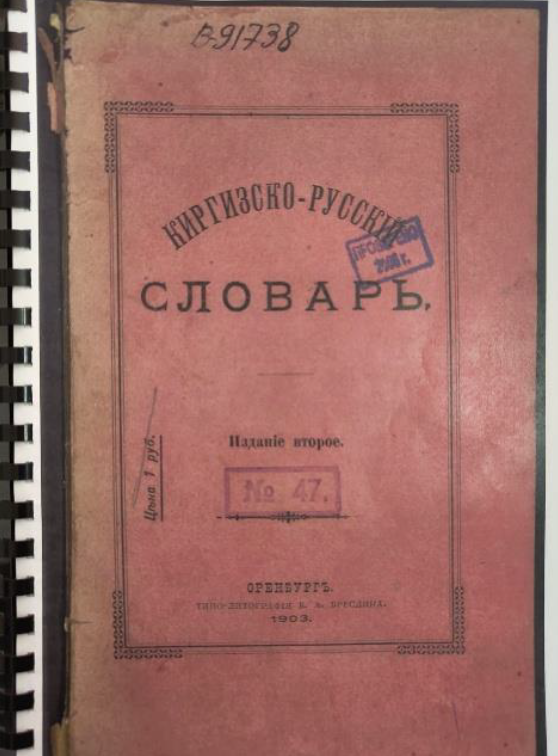
This article examines polysemous lexical units in the Kyrgyz–Russian Dictionary, a 19th-century lexicographic monument written in Cyrillic. Unlike many other peoples, Turkic peoples have employed a variety of writing systems throughout their written history. Among these, forms of the Arabic script were used for several centuries. Numerous encyclopedic, literary, historical, chronological, natural-scientific, and linguistic written monuments of the Turkic peoples were produced in the Arabic script. However, at the turn of the 19th and 20th centuries, historical and sociopolitical developments led Turkic peoples to gradually adopt the Latin and Cyrillic alphabets. The Russian Empire promoted the transition of Turkic peoples to the Cyrillic script, relying in part on the educated population. In the Kazakh steppe, representatives of the Kazakh intelligentsia contributed to this process by promoting literacy and education and disseminating literary and religious texts, self-study manuals, and dictionaries. One such publication was the Kyrgyz–Russian Dictionary, published in two editions, in 1897 and 1903. The dictionary is a unique lexicographic monument in which linguistic information and cultural knowledge are closely intertwined, reflecting the traditions and customs of the Kazakh people. Through the integration of linguistic and extralinguistic knowledge, the dictionary provides insights into the language, culture, and worldview of the Kazakh people at the turn of the century. From a linguistic perspective, the dictionary is notable for its rich historical vocabulary and abundance of polysemous lexical units. To reveal the semantic potential of lexical units, polysemy is examined from the perspectiveтof the semiotic system. In objective reality, however, the relationship between a sign and its linguistic meaning may vary. When the content or scope of a sign fully corresponds to its linguistic meaning, monosemy (a single meaning) arises. Conversely, discrepancies between the content of a sign and its linguistic meaning give rise to polysemy. The analysis of the lexical units presented in the dictionary confirms this theoretical understanding of the nature of polysemy. The authors identify the lexical-semantic variants (LSVs) of polysemous words and determine their common and differential sememes. The latter make it possible to establish the semantic relationships among the LSVs. The analysis of polysemous lexical units in the dictionary demonstrates the asymmetrical relationship between linguistic signs and meanings in Turkic languages. To investigate the continuity of lexical semantics throughout historical development, the article provides a comparative analysis of polysemous words found in the dictionary with their counterparts in Old Turkic and later historical periods, as well as with corresponding forms in modern Kazakh and Kyrgyz. The lexical corpus of this written monument also demonstrates the semantic richness of Turkic languages, the historical transformation of lexical meanings, and the continuity of these meanings across historical periods and in contemporary Turkic languages.
Downloads
Reference
Aksan D., 2004. Türkçenin Sözvarlığı: Türk Dilinin Sözlükbilimiyle İlgili Gözlemler, Saptamalar: 3. Basım. Ankara: Ünal Ofset Basımevi. 250 s.
Apresyan Yu.D., 1995. Izbrannye trudy. T. 1. Leksicheskaya semantika [Selected Works. Vol. 1. Lexical Semantics]. 2nd ed., rev. and enl. Moscow: Shkola «Yazyki russkoi kultury». 472 p. [in Russian].
Boz E., 2017. Sözlükbilim Yazıları I. Gazi Kitabevi. 228 p.
Bukvar dlya kirgizov. Zhazuga üiretetün knege, 1897. [Primer for the Kirghiz. A Book for Learning to Read and Write]. 3rd ed. Orenburg: Tipo-litografiya B.A. Breslina. 90 p. [in Russian].
Bukvar dlya kirgiz. Bukuar, 1908. [Primer for the Kirghiz]. Kazan: Tsentralnaya tipografiya. 98 p. [in Russian].
Drevnetyurkskii slovar, 1969. [Old Turkic Dictionary]. Eds. V.M. Nedelyaev, D.M. Nasilov, E.R. Tenishev, A.M. Shcherbak. Leningrad: Nauka. 677 p. [in Russian].
Drevnetyurkskii slovar, 2016. [Old Turkic Dictionary]. 2nd rev. ed. Ed. D.M. Nasilov. Astana: Gylym Baspasy. 760 p. [in Russian].
Ezgilikke üiretetin knege. Uchilishche blagochestiya na kirgizskom yazyke, 1892. [Book Teaching Virtue. School of Piety in the Kirghiz Language]. 3rd ed. Kazan: Pravoslavnoe Missionerskoe Obshchestvo. 87 p. [in Russian].
Zhubanov Q., 1966. Qazaq tili zhönindegi zertteuler [Studies on the Kazakh Language]. Almaty: Gylym. 362 p. [in Kazakh].
Kazhibekov E., 1988. Semantika tyurkskogo slova. Problemy mezhurovnevoi sopryazhennosti [Semantics of the Turkic Word: Problems of Interlevel Correlation]. Abstract of Dr. Sci. dissertation. Alma-Ata. 64 p. [in Russian].
Qazaq tiliniñ sözdigi, 1999. [Dictionary of the Kazakh Language]. Almaty: A. Baitursynuly Institute of Linguistics, Daik-Press. 775 p. [in Kazakh].
Kartsevskii S.O., 1965. Ob asimmetrichnom dualizme lingvisticheskogo znaka [On the Asymmetrical Dualism of the Linguistic Sign]. In: Zvegintsev V.A. Istoriya yazykoznaniya XIX–XX vekov v ocherkakh i izvlecheniyakh. Moscow: Nauka. P. 56–76. [in Russian].
Keñesbaev I., 1987. Qazaq til bilimi turaly zertteuler [Studies in Kazakh Linguistics]. Almaty: Gylym. 352 p. [in Kazakh].
Kirgizsko-russkii slovar, 1897. [Kirghiz–Russian Dictionary]. Orenburg: Tipo-litografiya B.A. Breslina. 229 p. [in Russian].
Kirgizsko-russkii slovar, 1903. [Kirghiz–Russian Dictionary]. 2nd ed. Orenburg: Tipolitografiya B.A. Breslina. 235 p. [in Russian].
Kobozeva I.M., 2007. Leksicheskaya semantika [Lexical Semantics]. 3rd ed. Moscow: KomKniga. 352 p. [in Russian].
Krongauz M.A., 2001. Semantika [Semantics]. Moscow: Russian State University for the Humanities. 399 p. [in Russian].
Makhmudov Kh., Musabaev G., 1954. Kazakhsko-russkii slovar [Kazakh–Russian Dictionary]. Ed. G. Musabaev. Alma-Ata: Academy of Sciences of the Kazakh SSR. 574 p. [in Russian].
Musaev K., 1984. Leksikologiya tyurkskikh yazykov [Lexicology of the Turkic Languages]. Moscow: Nauka. 226 p. [in Russian].
Nikitin M.V., 1988. Osnovy lingvisticheskoi teorii znacheniya [Foundations of the Linguistic Theory of Meaning]. Moscow: Vysshaya shkola. 168 p. [in Russian].
Novikov L.A., 1982. Semantika russkogo yazyka [Semantics of the Russian Language]. Moscow: Vysshaya shkola. 272 p. [in Russian].
Russko-kazakhskii slovar, 1954. [Russian–Kazakh Dictionary]. Ed. N.T. Sauranbaev. Moscow: State Publishing House of Foreign and National Dictionaries. 935 p. [in Russian].
Sevortyan E.V., 1989. Etimologicheskii slovar. Obshchetyurkskie i mezhtyurkskie osnovy na bukvy "Zh", "I [Etymological Dictionary. Common Turkic and Inter-Turkic Roots Beginning with "Zh" and "I"]. Vol. 4. Ed. L.S. Levitskaya. Moscow: Nauka. 293 p. [in Russian].
Sravnitelno-istoricheskaya grammatika tyurkskikh yazykov. Pratyurkskii yazyk-osnova. Kartina mira pratyurkskogo etnosa po dannym yazyka, 2006. [Comparative-Historical Grammar of the Turkic Languages. Proto-Turkic Language and the Worldview of the Proto-Turkic Ethnos]. Eds. E.R. Tenishev, A.V. Dybo. Moscow: Nauka. 908 p. [in Russian].
Tatar leksikologiyase, 2015. [Tatar Lexicology]. In 3 vols. Project leader M.Z. Zakiev. Ed. G.R. Galiullina. Kazan: TÄHSI. 352 p. [in Tatar].
Yudakhin K.K., 1985. Kyrgyzcha oruscha sözdük [Kyrgyz–Russian Dictionary]. Book 1. Moscow: Sovetskaya entsiklopediya. 475 p. [in Kyrgyz].
Shaimerdinova N., 2016. Analysis of consonant system in the Kazakh written monuments of the late 19th and early 20th centuries. Ural-Altaic Studies. Vol. 23. No 4. P. 147–156.
Shaimerdinova N.G., 2016. Sravnitelnyi analiz yazyka kirgizskikh/kazakhskikh pamyatnikov XIX–XX vekov i sovremennogo kazakhskogo yazyka [Comparative Analysis of the Language of the Kirghiz/Kazakh Written Monuments of the 19th–20th Centuries and the Modern Kazakh Language]. Global-Turk: International Journal for Information and Analytics. P. 158–175. [in Russian].
Shaimerdinova N.G., 2018. Slovarnyi fond kazakhskikh kirillicheskikh pamyatnikov na rubezhe XIX–XX vv. [Vocabulary of Kazakh Cyrillic Monuments at the Turn of the 19th–20th Centuries]. Materialy III Foruma gumanitarnykh nauk "Velikaya Step". Part I. Astana: Turkic Academy. P. 492–500. [in Russian].
Shaimerdinova N.G., 2019. "Kirgizsko-russkii slovar" (1897): kulturnye i yazykovye eksplikatsii ["Kirghiz–Russian Dictionary" (1897): Cultural and Linguistic Explications]. Turkic Studies Journal. No 1. P. 73–88. [in Russian].
Downloads
Published
How to Cite
Issue
Section
License
Copyright (c) 2026 Н.Г. Шаймердинова, А.Ш. Юсупова, Н. Рахаткызы

This work is licensed under a Creative Commons Attribution-NonCommercial 4.0 International License.