The lexical-semantic classification of toponyms in eastern sources
Views: 0 / PDF downloads: 0
DOI:
https://doi.org/10.32523/2664-5157-2026-3-187-211Keywords:
toponymy, anthropotoponymy, oikonymy, lexical semantic classification, Arabic-Persian sources, Turkic toponymy, eastern sources, potamotoponym, dromonym, tribeAbstract
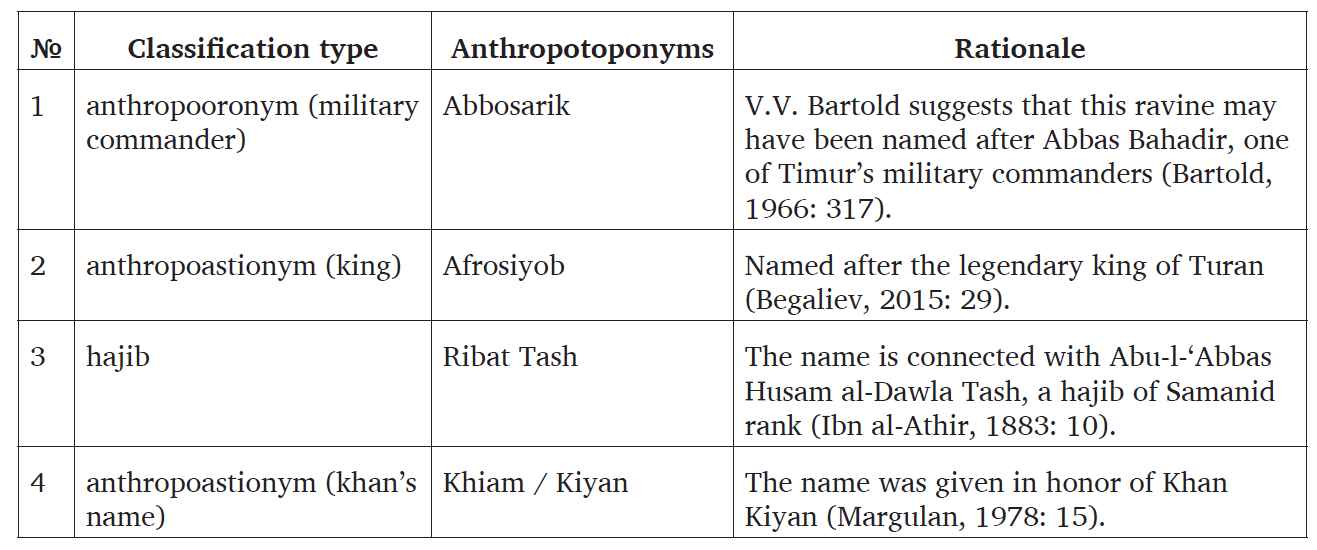
The study of toponyms within the territory of Kazakhstan and Uzbekistan as recorded in medieval Arab-Persian sources is the focus of this article. Analyzing these toponyms allows us to identify shared historical and cultural information among Turkic peoples, as well as key extralinguistic factors from that era. A total of 250 toponyms were collected from Eastern sources dating from the 9th to 12th century and categorized from a lexicological perspective. This study provides a comprehensive review of the scholarly literature on the lexicostatistical classification of proper names in general onomastics, as well as research dedicated to Arab-Persian historical documents. The methodological framework comprises lexicostatistical, comparative diachronic, contextual, and component analyses. Given that the source material consists of ancient geographical names, grouping, classification, and partial etymological analyses were also applied. The study examines the foundational meanings of ancient Turkic roots in these place names, enabling a historical evaluation of shared Turkic semantics. The primary analytical focus is on clarifying the lexicostatistical classification of ancient toponyms, establishing their overarching Turkic commonality, and mapping their spatial distribution. Toponyms formed from personal names and geographical terms in the works of renowned Eastern travelers, including al-Ya'qubi, Ibn Khordadbeh, Qudama, al-Istakhri, al-Bakri, and al-Idrisi (Abu Abdallah Muhammad), were subclassified based on specific motivations, such as kings, khans, historical figures, mountains, rivers, and cities. Since this material has not been compiled or analyzed comprehensively before, identifying these ancient place names and their origins provides historical toponymy with new data. Identifying toponyms in Arab-Persian sources is essential to determining the routes of medieval international relations, spatial locations, and place names formed via transonymization. Furthermore, ethnotoponyms reveal valuable information about the tribes inhabiting these regions between the 9th and 12th centuries. The analyzed toponyms are clarified using available historical data, and their formative motivations are thoroughly explained. Based on existing scholarly etymologies, supplementary context provided by Arab-Persian travelers regarding each location is included. Tables are provided for each lexicostatistical type, specifying the classification category, the toponym, and the motivation. Investigating motivations such as personal and tribal names, geographical terms, physical features, socially significant neutral words, and obscurely motivated names establishes a basis for future comparative research. This study aims to perform a lexicostatistical analysis of ancient Turkic toponyms in Eastern sources, systematize their taxonomy, and identify their linguistic and historical-cultural features. The study's relevance lies in analyzing linguistic materials that establish Turkic unity as nations define their global identities. Ultimately, the results will serve as a foundation for systematizing Turkic toponymic semantics and will support future research in comparative lexicology.
Downloads
Reference
Al-İdrisi, 2020. Abu ‘Abd Allah Muhammad ibn Muhammad aş-Şarif al-İdrisi. Nuzhat al-muştak fi-ihtirak al-afak. İzd. Ahmad Farid al-Mazidi [Abu ‘Abd Allah Muhammad ibn Muhammad aş-Şarif al-İdrisi. Nuzhat al-muştak fi-ihtirak al-afak. İzd. Ahmad Farid al-Mazidi]. Bairut: Dar al-kutub al-‘ilmiia. P. 17-29. [in Russian].
Al-Mukaddasi, 1876. Ahsan at-takasim fi ma'rifat al-akalim. İzd. De Gue [Ahsan at-takasim fi ma'rifat al-akalim. Ed. De Gue]. BGA. Leiden, III. P. 12-38. [in Russian].
Al-Kufi, 1991. Abu Muhammad Ahmad ibn A‘sam al-Kufi. Kitab al-Futuh. İzd. ‘Ali Şiri. V 8 tomah [Abu Muhammad Ahmad ibn A'sam al-Kufi. Kitab al-Futuh / Ed. ‘Ali Shiri. In 8 volumes]. Bairut: Dar al-Adva’. P. 14-33. [in Russian].
Alimkhan A.A., 2025. Ulttyq onomastikanıñ lingvomädeni negizderi [Linguocultural foundations of national onomastics]. Almaty: Evero. 250 p. [in Kazakh].
Äbdırahmanov A., 1975. Toponimika jäne etimologia [Toponymy and etymology]. Almaty. 137 p. [in Kazakh].
Bababekov X., 1987. K etimologii toponima «Kokand». H. Bababekov. İz istorii Srednei Azii i Vostochnogo Turkestana XV–XIX vv. [To the etymology of the toponym "Kokand". Kh. Bababekov. From the history of Central Asia and East Turkestan 15th–19th centuries]. Taşkent. P. 98-104. [in Russian].
Baidaliev D.D., 2007. Jualy ölkesınıñ ejelgı tarihy [The ancient history of the Zhualy region]. Taraz. 213 p. [in Kazakh].
Baipakov K.M., 2007. Veliki Şelkovyi püt na teritorii Kazahstana [The Great Silk Road on the Territory of Kazakhstan]. Almaty: Alamar. 496 p. [in Russian].
Bartöld V., 1965. Sochinenia. III tom [Works. Volume III.] [Elektronnyi resurs]. file:///C:/Users/pc/Desktop/PSF_24-27/Bartold_V_V_Sochinenia_M_1965_T_3.pdf [in Russian]. (Accessed: 29.02.2026)
Bartöld V., 1966. Sbornik sochineni [Collection of essays]. [Elektronnyi resurs]. file:///C:/Users/pc/Desktop/PSF_24-27/Bartold_V_V_Sochinenia_M_1966_T_6.pdf [in Russian]. (Accessed: 20.03.2026)
Bartöld V., 1974. Sbornik sochineni [Collection of Works]. [Elektronnyi resurs]. file:///C:/Users/pc/Desktop/PSF_24-27/Bartold_V_V_Sochinenia_M_1974_T_7.pdf [in Russian]. (Accessed: 10.03.2026)
Bartöld V., 1973. Sbornik sochineni [Collection of Works]. [Elektronnyi resurs]. file:///C:/Users/pc/Desktop/PSF_24-27/Bartold_V_V_Sochinenia_M_1973_T_8.pdf [in Russian]. (Accessed: 09.01.2026)
Begaliev N.B., Turobov A.M. Samarqand toponimiasi. SamDChTİ naşri [Toponymy of Samarkand. Samdech Technische Hochschule], 2015i. 156 p. [in Russian].
Beleniski A.M., Bentovin N. B., Bölşakov O. G., 1973. Srednevekovyi gorod Srednei Azii [Medieval city of Central Asia]. L. 393 p. [in Uzbek].
Bernştam A.N., 1952. İstoriko-arheologicheskie ocherki Senträlnogo Tän-Şanä i Pamiro-Altaia [Historical and archaeological essays on the Central Tien Shan and Pamir-Altai]. Moscow-Leningrad. 343 p. [in Russian].
Biarov B., 2013. Qazaq toponimderınıñ tiptık ülgılerı. Ş. Şaiahmetov atyndağy Tılderdı damytudyñ respublikalyq ädıstemelık ortalyğy [Typical examples of Kazakh toponyms. Republican Methodological Center for Language Development named after Sh. Shayakhmetov]. 432 p. [in Kazakh].
Buräkov İu., 2002. K istorii ranesrednevekovogo Chacha. O’zbekiston tarihi [On the history of early medieval Chach. History of Uzbekistan]. №3. P. 10-20. [in Russian].
Drevnetürski slovär [Ancient Turkic Dictionary], 1969. Leningrad. 589 p. [in Russian].
Janūzaq T., 2010. Tarihi jer-su attarynyñ tüptörkını [The origins of historical place names]. Almaty: "Sözdık-slovär" JŞS. 356 p. [in Kazakh].
Jūmabekov J.A., Ahmetjanova N.J., 2014. Ūlytau öñırınıñ tarihi toponimikasy. Qarağandy universitetınıñ habarşysy [Historical toponymy of the Ulytau region. Bulletin of Karaganda University]. «İstoria. Filosofia» seriasy, № 4(76). P. 17-26. [in Kazakh].
Zaҳiriddin Muҳammad Bobur, 2002. Boburnoma [Baburnama]. T.: Şarq. 139 p. [in Uzbek]. İakut, 1950. Mu'jam al-buldan [Mu'jam al-buldan]. Beirut. tt. I – IV. 500 p. [in Russian].
İbn al-Asir, 1883-1885. Abu-l-Hasan ‘Ali ibn Muhammad aş-Şaibani al Jazari İbn al-Asir. Al-Kamil fi-t-ta’rih. V 12 tomah [Abu-l-Hasan ‘Ali ibn Muhammad ash-Shaybani al-Jazari Ibn al-Athir. Al-Kamil fi-t-ta’rikh. In 12 volumes]. Misr: Bulak. 664 p. [in Russian].
İbn al-Fakih, 1977. izd. s. As-Savad i Tabaristan po Meşhedskoi rukopisi truda İbn al-Fakiha al-Hamadani. İzd. arab, teksta, perevod i primechania O. V. Skitişvili [Publishing house – As-Sawad and Tabaristan according to the Mashhad manuscript of the work of Ibn al-Faqih al-Hamadani. Publishing house – Arabic, text, translation and notes by O. V. Tskitishvili]. Tbilisi. 83 p. [in Russian].
İbn Hordadbeh, 1986. Kniga putei i stran. Perevod s arabskogo, komentarii, issledovanie, ukazateli i karty Naili Velihanovoi [The Book of Routes and Countries. Translation from Arabic, commentary, research, indexes and maps by Naila Velikhanova]. Baku: Elm. 428 p. [in Russian].
Kaidarov A.T., 1986. Struktura odnoslojnyh kornei i osnov v kazahskom iazyke [Structure of monosyllabic roots and bases in the Kazakh language]. Alma-Ata. 322 p. [in Russian].
Kamaliddin Ş., 2007. K etimologii nazvania Chach (Şaş). Materialy nauchnoi konferensii «Chach – Binket – Taşkent (istoricheskoe proşloe i sovremennost)» [On the etymology of the name Chach (Shash). Proceedings of the scientific conference "Chach - Binket - Tashkent (historical past and present)"]. Tashkent. P. 45-51. [in Russian].
Koşğari M., 1963. Turki sўzlar devoni (Devonu- luğot it-turk). Tarjimon va naşrga taiörlovchi S. M. Mutallibov. 3 tomlik [urkish words of Devoni (Devonu-lugot it-Turk). Translator and publisher S.M. Mutallibov. 3 volumes]. Tashkent: Fan. 428 p. [in Uzbek].
Kumekov B. E., 1971. Strana kimakov po karte al-İdrisi. SNV, vyp. 10 [The country of the Kimaks according to the map of al-Idrisi. SNV, issue 10]. Moscow: Nauka. P. 194–198. [in Russian].
K etimologii gidronima Balhaş. Problemy drevnei i srednevekovoi istorii Chacha. Vyp. 10. Otv. red. Ş. S. Kamoliddin [On the Etymology of the Hydronym Balkhash. Problems of Ancient and Medieval History of Chach. Issue 10. Ed. Sh. S. Kamoliddin], 2023. Saarbrücken: LAP. P. 87–96. [in Russian].
Kriticheskoe izdanie teksta äl-İstahri dal de-Gue v pervom tome Bibliotheca Geographorumarablcorum [A critical edition of al-Istakhri's text was given by de Goué in the first volume of Bibliotheca Geographorumarablcorum], 1937. Leiden 408 p. [in Russian].
Qazaq tılınıñ dialektologialyq sözdıgı. A. [Dialectological dictionary of the Kazakh language. A.], 1969. 426 p. [in Kazakh].
Qazaq tılınıñ tüsındırme sözdıgı [Explanatory dictionary of the Kazakh language], 1986. Almaty. 512 p. [in Kazakh].
Qoişybaev E., 1985. Qazaqstannyñ jer-su attary sözdıgı [Dictionary of place names of Kazakhstan]. Almaty: Mektep. 256 p. [in Kazakh].
Qoraev S., 1970. Geografik nomlar manosini bilasizmi? [Do you know the meaning of geographical names?]. T., Uzbekistan. 67 p. [in Uzbek].
Margulan A., 1978. Arheologicheskie pamätniki Kazahstana [Archaeological monuments of Kazakhstan]. Almaty: İzd-vo Nauka. 214 p. [in Russian].
Mirakmalov M.T., 2007. O‘zbekiston oikonimlarining tasnifi, O‘zbekiston geografiya jamiyati yilnomalari, jild. 29 [v]. P. 21-23. [in Uzbek].
Mūhammejanov A., 1988. Qadimgi Toşkent [Ancient Tashkent]. Tashkent. 124 p. [in Uzbek].
Murzaev E.M., 1982. Geografia v nazvaniah. Moskva. 176 s. [Murzaev E.M., 1982. Geography in names. Moscow. 176 р.] [in Russian].
Murzaev E.M., 1984. Slovär narodnyh geograficheskih terminov [Dictionary of folk geographical terms]. M. 653 p. [in Russian].
Nalivkin V.P., 1886. Kratkaia istoria Kokandskogo hanstva. V.P. Nalivkin [Short history of the Kokand Khanate. V.P. Nalivkin]. Kazän: Kazanski universitet. 225 p. [in Russian].
Semönov-Tän-Şanski V.P., 1924. Kak geograficheski landşaft otrajaetsä v narodnyh nazvaniah naselennyh punktov? Antropogeograficheskoe issledovanie, Nauki o Zemle, t., 26, № 1-2 ["How is the geographical landscape reflected in the popular names of populated areas?" Anthropogeographical study. Earth Sciences, Vol. 26, No. 1-2]. P. 133-158. [in Russian].
Stewart G.R., 1970. A Concise and Selective Dictionary for the Continental United States of America. New York, Oxford: Oxford University Press. ISBN: 0195001214, ISBN13: 9780195001211. 550 p.
Syzdyqov S., 2018. Qarlyqtardyñ ruhani jäne materialdyq mädenietı [Spiritual and material culture of the Karlyks] [Elektrondyq resurs]. https://e-history.kz/kz/news/show/1960?ysclid=mno30iexd8235846408 [in Kazakh]. (Accessed: 12.12.2025)
Trudy Semirechenskoi arheologicheskoi ekspedisii: Chuiskaia dolina. Sost. Pod red. Bernştam A.N. [Works of the Semirechye archaeological expedition: Chuya Valley. Comp. Ed. by A.N. Bernshtam], 1950. Moscow-Leningrad. 249 p. [in Russian].
Hudud, 1937. «Hudud – al-alam» the regions of the world. Tran. and explaned by V. Minorsky. London. P. 211-218.
Shaniazov K.Ş., 1973. Etnograficheskie materialy v trudah Beruni. Beruni na ijtimoi fanlar [Ethnographic materials in the works of Beruni. Beruni on social sciences]. Tashkent. 342 p. [in Russian].
İuchkevich V.A., 1968. Obşaia toponimika [General toponymy]. Minsk. 432 p. [in Russian].
İailenko V.P., 1988. Paleoaziaty i etnicheskaia istoria drevnei Srednei Azii. Problemy etnogeneza i etnicheskoi istorii narodov Srednei Azii i Kazahstana. (TD) [Paleoasians and the ethnic history of ancient Central Asia. Problems of the ethnogenesis and ethnic history of the peoples of Central Asia and Kazakhstan. (TD)]. M. P. 132 – 134. [in Russian].
Al-Jaköbi, 1892. Kitäb al-boldän. (Bibliotheca Geographorum Arabicornm, M. J. De-Goeje, t. VII) [Kitäb al-boldän. (Bibliotheca Geographorum Arabicornm, M. J. De-Goeje, t. VII)]. Leiden. P. 232–233. [in Limburgish].
De Gоeje М. J., 1889. Kitab al-masalik wa-l-mamalik auctore... etc. Accedunt excerpta e Kitab al-Kharadj auctore Kodama ibn Dja'far. Lugduni Batavorum (BGA, VI) [Kitab al-masalik wa-l-mamalik by... etc. Excerpts from Kitab al-Kharadj by Kodama ibn Dja'far. Lugduni Batavorum (BGA, VI)]. 548 p. [in Latin].
Description de l’Afrique septentrionale par el-Békri, éd. et trad. Mac Guckln de Sla ne, texte, nouvelle éd. [Description of North Africa by el-Bekri, ed. and trans. Mac Guckln de Slane, text, new ed.], 1913. 405 p. [in French].
Gusev D., Stafeev S., 2024 A Digital Georeferenced Reconstruction of al-Biruni's Map from The Masʿud Canon. International Cartographic Association, Commission on Cartographic Heritage into the Digital 18th ICA Conference Digital Approaches to Cartographic Heritage Bologna, 23-25 October. P.198-223.
Mirakmalov M.T. O‘zbekiston oikonimlarining tasnifi. O‘zbekiston geografiya jamiyati yilnomalari [Classification of Oikonyms of Uzbekistan. Annals of the Geographical Society of Uzbekistan] Vol. 29, 2007. 21-23-b. [in Uzbek].
Hasanov H., 1985. Geografik nomlarning siri: ilmiy – ommabop ta'rif [The Secret of Geographical Names: Scientific and Popular Definition]. Tashkent. 120 p. [in Uzbek].
Stewart G.R., 1970. A Concise and Selective Dictionary for the Continental United States of America. New York, Oxford: Oxford University Press. ISBN: 0195001214, ISBN13: 9780195001211. 550 p.
Downloads
Published
How to Cite
Issue
Section
License
Copyright (c) 2026 С.К. Иманберди, M. Экиджи, A. Асеткызы

This work is licensed under a Creative Commons Attribution-NonCommercial 4.0 International License.