Stone Sculptures Depicting Umai (Katun) in Kyrgyzstan
Views: 700 / PDF downloads: 322
DOI:
https://doi.org/10.32523/2664-5157-2025-2-106-127Keywords:
stone sculptures, statue, "three-horned" headdress, Tengri, Umai, khagan, katun, archaeological findings, memorial complexes, Turkic Khaganate.Abstract
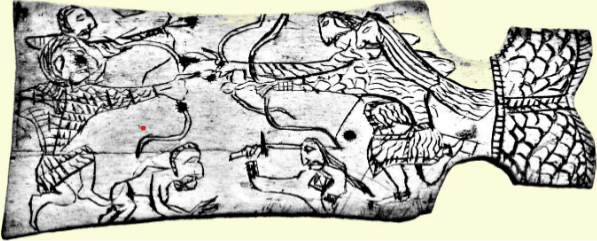
The paper provides an overview of stone sculptures featuring figures with a distinctive ‘three-horned’ headdress and presents new findings of similar imagery. The geographic distribution of this motif has expanded over time across Central Asia. These depictions, found on coins, bone plaques, and stones, frequently appear alongside male figures, resembling carvings on stone sculptures. These images are generally interpreted as representations of the deity Umai or her earthly counterparts – either a female shaman or the khagan’s consort. The recurrence of scenes showing a long-haired male figure next to a person wearing a “three-horned” headdress suggests the prevalence of this iconographic pairing in early medieval Turkic culture. This imagery reflects the symbolic alignment of the khagan and his wife with deities Tengri and Umai, reinforcing the khagan’s authority. Such ideological expressions appear in memorial complexes, featuring sculptures of rulers and their spouses, as well as in official coinage, and other forms of artistic representation. Over time, the image of the woman in the “three-horned” headdress acquired broader cultural significance, extending even into family memorial enclosures. With the spread of Islam, the prominence of Umai diminished; however, her influence persisted in rituals, magical practices, and folklore. Ethnographic records suggest that Umai was sometimes associated with powerful women or experienced midwives, underscoring her enduring cultural relevance. Oral traditions continue to preserve vivid descriptions of her appearance. The term katun (also khatun), historically used to denote the wives of Turkic and Mongol rulers, has ancient Turkic roots. Although its exact etymology remains uncertain, linguistic analysis suggests derivation from the verb kat- (“to join, to add”) with the nominal suffix -yn, meaning ‘joined’. This etymological structure parallels the word kelin (kel- meaning ‘to come’), denoting a 'newcomer’. Originally meaning ‘wife’ or ‘woman,’ the term katun//katyn//kadyn evolved during the Turkic Khaganate period to signify the consort of a ruler and was later adopted by Mongol rulers. This study highlights the evolving cultural and ideological significance of the ‘threehorned’ headdress and its role in Turkic societal structures.
Downloads
Reference
Abramzon S.M., 1990. Kirgizy i ih etnogeneticheskie i istoriko-kul'turnye svyazi [Kyrgyz and their Ethnogenetic and Historical-Cultural Connections]. Frunze. 480 p. [in Russian].
Abramzon S.M., 1976. O nekotoryh terminah rodstva v tyurkskih yazykah [On Some Kinship Terms in Turkic Languages]. TURKOLOGIA. K 70-letiyu akademika A.N. Kononova [TURKOLOGIA. In Honor of Academician A.N. Kononov’s 70th Anniversary]. L.: Nauka. P. 204-207. [in Russian]
ARS, 2018. Altajsko-russkij slovar' [Altai-Russian Dictionary]. Gorno-Altajsk, 2018. 936 p. [in Russian]
Ahinzhanov S.M., 1978. Ob etnicheskoj prinadlezhnosti kamennyh izvayanij v «trekhrogih» golovnyh uborah iz Semirech'ya [On the Ethnic Affiliation of Stone Figures with "Three-Horned" Headgear from Semirechye]. Arheologicheskie pamyatniki Kazahstana [Archaeological Monuments of Kazakhstan]. Almaty, Nuka Kaz. SSR. P. 65-79. [in Russian]
Babayarov G., 2007. Drevnetyurkskie monety Chachskogo oazisa (VI-VIII vv. n.e.) [Ancient Turkic Coins from the Chach Oasis (6th-8th centuries AD)]. Izd-vo Nacional'noj biblioteki Uzbekistana im. Navoi [Publishing House of the National Library of Uzbekistan named after Navoi]. Tashkent. 120 p. [in Russian]
Varenov A.V., 2020. Vsadniki v trekhrogih golovnyh uborah na petroglifah Kitaya i ih sibirskie i central'noaziatskie sootvetstviya [Riders in Three-Horned Headgear on Petroglyphs of China and Their Siberian and Central Asian Equivalents]. Vestnik NGU. Seriya: Istoriya, filologiya [Bulletin of NSU. Series: History, Philology]. T. 19, No 10: Vostokovedenie. P. 35–49. https://vestnik.nsu.ru/historyphilology/files/e8f71d7f867921428ce8fb77edc86cd5.pdf [in Russian]
Gavrilova A.A., 1965. Mogil'nik Kudyrge kak istochnik po istorii altajskih plemyon [The Kudyrga Burial Site as a Source on the History of Altai Tribes]. M.-L., 1965. 145 p. [in Russian]
Dluzhnevskaya G.V., 1978. Eshche raz o «kudyrginskom valune» (k voprosu ob ikonografii Umaj u drevnih tyurkov) [Once Again About the "Kudyrga Boulder" (On the Iconography of Umay Among the Ancient Turks)]. Tyurkologicheskij sbornik [Turkological Collection]. M., P. 230-237. [in Russian]
Drevnosti Sibiri i Central'noj Azii [Antiquities of Siberia and Central Asia], 2010. Sbornik nauchnyh trudov / pod red. V.I. Soenova. Gorno-Altajsk: GAGU, P. 93-103. [in Russian]
Drevnost' i srednevekov'e [Antiquity and the Middle Ages], 2000. SPb.: Peterburgskoe vostokovedenie. («Orientalia»). 320 p. [in Russian]
DTS, 2016. Drevnetyurkskij slovar' [Ancient Turkic Dictionary]. Astana. 760 p. [in Russian]
Dybo A.V., 2013. Etimologicheskij slovar' tyurkskih yazykov [Etymological Dictionary of Turkic Languages]. Astana. 616 p. [in Russian]
Dyrenkova N.P., 1927. Brak, terminy rodstva i psihicheskie zaprety u kyrgyzov [Marriage, Kinship Terms, and Psychological Taboos Among the Kyrgyz]. Sbornik etnograficheskih materialov [Collection of Ethnographic Materials]. Leningrad. P. 7-25. [in Russian].
Ermolenko L.N., 1995. K probleme kamennyh izvayanij v «trekhrogih» golovnyh uborah [On the Stone Figures of "Three-Horned" Headgear]. Naskal'noe iskusstvo Azii [Rock Art of Asia]. Kemerovo: Kuzbassvuzizdat, Vyp. 1. P. 54-55. [in Russian]
Ibragimov M., 2005. Kyrgyz makal-ylakap, uchkul sөzdөrү [Kyrgyz Proverbs, Sayings, and Rare Words]. Kara-Balta. 500 p. [in Kyrgyz]
Klyashtornyj S.G., Sultanov T.I., 2000. Gosudarstva i narody evrazijskih stepejn [States and Peoples of the Eurasian Steppes]. SPb: Peterburgskoe vostokovedenie. 320 p. [in Russian]
Klyashtornyj S.G., 1981. Mifologicheskie syuzhety v drevnetyurkskih pamyatnikah [Mythological Themes in Ancient Turkic Monuments]. Tyurkologicheskij sbornik. M.: P. 117-138. [in Russian]
Kononov A.N., 1958. K etimologii slova ogul “syn” [On the Etymology of the Word "Ogul" ("Son")]. Filologiya i istoriya mongol'skih narodov. Pamyati akademika B.Ya. Vladimirceva [ Philology and History of Mongol Peoples. In Memory of Academician B.Ya. Vladimircev]. Moskva. P. 175-176. [in Russian]
KTTS, 2019. Kyrgyz tilinin tүshүndүrmө sөzdүgү [Kyrgyz Language Explanatory Dictionary]. Bishkek. 1458 p. [in Kyrgyz]
Kyzlasov I.L., 1998. Izobrazhenie Tengri i Umaj na Sulekskoj pisanice [Depiction of Tengri and Umay on the Sulekskaya Petroglyphs]. Etnograficheskoe obozrenie [Ethnographic Review]. No 4. P. 39-53. [in Russian]
Kubarev G.V., 2021. Izobrazhenie zhenshchiny v trekhrogom golovnom ubore iz Apshiyaktiy i ego istoriko-kul'turnyj aspekt [The Image of a Woman in Three-Horned Headgear from Apshiyakty and Its Historical-Cultural Aspect]. Drevnee iskusstvo v kontekste kul'turno-istoricheskih processov Evrazii: 300-letiyu nauchnogo otkrytiya Tomskoj pisanicy. Materialy mezhdunarodnoj konferencii [Ancient Art in the Context of Cultural-Historical Processes of Eurasia: The 300th Anniversary of the Scientific Discovery of the Tomsk Petroglyphs. Materials of the International Conference]. Kemerovo: Izd-vo KRIPKiPRO. P. 170-179. [in Russian]
Malov S.E., 1951. Pamyatniki drevnetyurkskoj pis'mennosti. Teksty i issledovaniya [Monuments of Ancient Turkic Writing. Texts and Research]. M.– L. 451 p. [in Russian]
Moldokulova D.T., 2016. Kyrgyzdardyn salttyk zhүrүm-turum madaniyaty (XIX kylymdyn ayagy - XX kylymdyn bashy) [The Traditional Culture of Kyrgyz Behavior (Late 19th - Early 20th Century)]. Bishkek. 150 p. [in Kyrgyz]
Moskvin V.P., 2001. Evfemizmy: sistemnye svyazi, funkcii i sposoby obrazovaniya [Euphemisms: Systemic Relationships, Functions, and Ways of Formation]. Voprosy yazykoznaniya. No3. P. 58-70. [in Russian]
Musaev K.M., 1974. Terminy rodstva v sovremennyh zapadnokypchakskih yazykah [Kinship Terms in Modern Western Kipchak Languages]. Sprachegeschicbite end Rultur der altaishenwoukor. Berlin. P. 170-184. [in Russian]
Rogozhinskij A.E., 2010. Novye nahodki pamyatnikov drevnetyurkskoj epigrafiki i monumental'nogo iskusstva na yuge i vostoke Kazahstana [New Finds of Ancient Turkic Epigraphy and Monumental Art in the South and East of Kazakhstan]. Rol' nomadov v formirovanii kul'turnogo naslediya Kazahstana [The Role of Nomads in the Formation of Kazakhstan's Cultural Heritage]. Almaty: Print-S. P. 329-344. [in Russian]
SIGTYA., 2001. Sravnitel'no istoricheskaya grammatika tyurkskih yazykov. Leksika [Comparative-Historical Grammar of Turkic Languages. Lexicon]. Moskva. 824 p. [in Russian]
TRS., 1994. Turecko-russkij slovar' [Turkish-Russian Dictionary]. Istanbul. 950 p. [in Russian]Potapov L.P., 1973. Umaj – bozhestvo drevnih tyurkov v svete etnograficheskih dannyh [Umay – The Deity of the Ancient Turks in the Light of Ethnographic Data]. Tyurkologicheskij sbornik. M., P. 265-286. [in Russian]
Pokrovskaya L.A., 1961. Terminy rodstva v tyurkskih yazykah [Kinship Terms in Turkic Languages]. Istoricheskoe razvitie leksiki tyurkskih yazykov [Historical Development of Turkic Languages' Lexicon]. Moskva. P. 11-81. [in Russian]
Hudyakov Yu.S., Tabaldiev K.Sh., Soltobaev O.A., 1997. Novye nahodki predmetov izobrazitel'nogo iskusstva drevnih tyurok na Tyan'-Shane [New Finds of Visual Artifacts from Ancient Turks in the Tian Shan Mountains]. Rossijskaya arheologiya. No 3. P. 142-147. [in Russian]
Hudyakov Yu.S., 2010. Ob izobrazhenii bozhestv drevnetyurkskogo panteona na pamyatnikah iskusstva nomadov Yuzhnoj Sibiri i Central'noj Azii epohi rannego srednevekov'ya [On the Depiction of Gods of the Ancient Turkic Pantheon on the Monuments of Art from the Nomads of Southern Siberia and Central Asia in the Early Middle Ages]. Drevnosti Sibiri i Central'noj Azii [Antiquities of Siberia and Central Asia]. Gorno-Altajsk: GAGU. No 3. P. 92-102. [in Russian]
Sher Ya.A., 1966. Kamennye izvayaniya Semirech'ya [Stone Figures of Semirechye]. M.; L.: Nauka, 138 p. [in Russian]
Yudahin K.K., 1965. Kirgizsko-russkij slovar' [Kyrgyz-Russian Dictionary]. Moskva. 973 p. [in Russian]
Clauson G., 1972. An Etymological Dictionary of Pre-Thirteenth-Century Turkish. Oxford. 988 p. Doerfer G., 1967. Türkische und mongolische Elemente im Neupersischen. III. Wiesbaden. 670 p. [in German]
Islam Ansiklopedisi, 1997. Vol. 16. Istanbul. 560 p. [in Turkish]
Jumakunova G., 2021. Kırgız Dilinde Soya Dayalı Akrabalık Terimleri. KutBilim, Vol.1, No.1. P. 1-19. [in Turkish]Yong-Söng Li., 1999. Türk Dillerinde Akrabalık Adları. İstanbul. 415 p. [in Turkish].
Downloads
Published
How to Cite
Issue
Section
License
Copyright (c) 2025 Turkic Studies Journal

This work is licensed under a Creative Commons Attribution-NonCommercial 4.0 International License.