
A comprehensive study of a Turkic-Period statue from the collection of the national historical museum of the Kyrgyz Republic
Views: 0 / PDF downloads: 0
DOI:
https://doi.org/10.32523/2664-5157-2026-3-33-50Keywords:
Kyrgyzstan, National Historical Museum, stone statue, Early Middle Ages period, Turkic time, photogrammetry, digital technologies, images, cultural and chronological context, Turgesh KhaganateAbstract
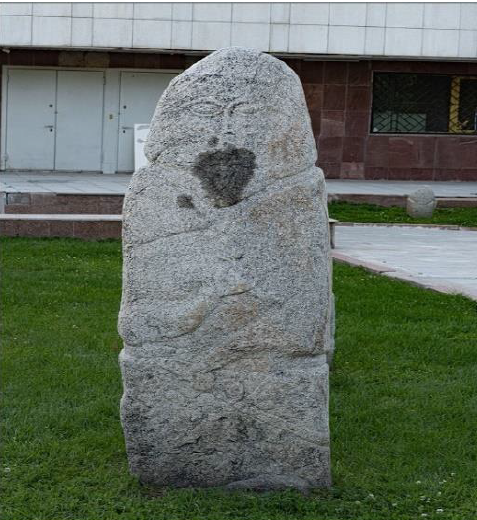
Modern science is inconceivable without information technology, especially in fields that rely on field and experimental research. This is particularly relevant to archaeology, where comprehensively studying sites and artifacts is fundamental to the discipline. Traditional methods of archaeology, which require direct contact with objects, are often insufficiently effective or destructive. Despite its obvious advantages, directly examining an artifact has limitations. For example, many parameters are technically difficult or impossible to measure without causing damage. One solution to this and many other problems is digitizing archaeological objects using modern technology to create high-precision digital models that are virtually identical to the originals. This approach enables the acquisition of large data sets and facilitates repeated, comprehensive research. Digital copies allow for precise measurements of linear parameters, volumes, and angles, as well as analysis of surface texture and geometry. They also enable the identification of defects, documentation of tool marks, and generation of virtual cross-sections. This approach is particularly important for documenting and studying ancient and medieval stone sculptures. This article presents the results of using photogrammetry to create a digital copy of one of the significant artifacts housed in the National Historical Museum of the Kyrgyz Republic (Bishkek) and perform a detailed analysis of its imagery. The large-scale, three-dimensional sculpture of a male warrior was discovered near the village of Ichke-Suu in the Tup District of the Issyk-Kul Region. The newly published renders, geometric views, and graphic tracings provide a basis for examining not only the figure’s appearance, hairstyle, and costume details, but also the material culture items characteristic of the Early Middle Ages, particularly weaponry. The analogies provided have made it possible to date the artifact complex depicted on the sculpture to the late seventh – early eighth centuries. This corresponds to the period of the Turgesh Khaganate (699–756). The detailed sculpture should be classified as one of its artifacts. While creating digital replicas of stone sculptures and other archaeological objects requires financial investment, the results facilitate effective scientific research and provide high-quality museum visualization.
Downloads
Reference
Bayar D., Amartuvshin Ch., Enkhtor A., Gerelbadrakh J., 2021. Bilge haany ünet erdenes [Precious treasures of Bilge Khan] (Admon print LLC. Ulaanbaatar. 140 p.). [in Mongolian].
Charikov A.A., 1976. Rannesrednevekovye skulptury iz Vostochnogo Kazakhstana [Early Medieval Sculptures from Eastern Kazakhstan], Sovetskaya arkheologiya [Soviet Archaeology]. No. 4. P. 153–165. [in Russian].
Ermolenko L.N., 2004. Srednevekovye kamennye izvayaniya kazahstanskih stepej (tipologiya, semantika v aspekte voennoj ideologii i tradicionnogo mirovozzreniya) [Medieval stone statues of the Kazakh steppes (typology, semantics in the aspect of military ideology and traditional worldview)] (Publishing House of the Institute of Archaeology and Ethnography of the SB RAS. Novosibirsk. 132 p.). [in Russian].
Evtyuhova L.A., 1948. Arkheologicheskie pamyatniki eniseyskikh kyrgyzov (khakasov) [Archaeological Sites of the Yenisei Kyrgyz (Khakas)]. (KHAKNIIYaLI. Abakan. 110 p.). [in Russian].
Evtyuhova L.A., 1952. Kamennye izvayaniya Yuzhnoy Sibiri i Mongolii [Stone Statues of Southern Siberia and Mongolia], Materialy i issledovaniya po arkheologii SSSR [Materials and Research on the Archaeology of the USSR]. No. 24. P. 72–120. [in Russian].
Gorbunov V.V., 2006. Voennoe delo naseleniya Altaya v III–XIV vv. Chast' II: Nastupatel'noe vooruzhenie (oruzhie) [Military affairs of the Altai population in the 3rd–14th centuries. Part II: Offensive weapons (arms)] (Altai University Press. Barnaul. 232 p.). [in Russian].
Gorbunov V.V., 2014. Dlinnoklinkovoe oruzhie tyurkskoj konnicy [Long-bladed weapons of the Turkic cavalry], Vojna i oruzhie. Novye issledovaniya i materialy: trudy Pyatoj Mezhdunarodnoj nauchno-prakticheskoj konferencii [War and weapons. New research and materials: proceedings of the Fifth International Scientific and Practical Conference] (Military Historical Museum of Artillery, Engineers and Signal Corps. Saint Petersburg. Part I. P. 385–401). [in Russian].
Grach A.D., 1964. Drevnetyurkskie izvayaniya Tuvy [Ancient Turkic Stone Statues of Tuva]. (Vostochnaya Literatura. Moscow. 94 p.). [in Russian].
Khudyakov Yu.L., Tabaldiev K.Sh., 2009. Drevnie tyurki na Tyan'-Shane [Ancient Turks in the Tien Shan] (Publishing House of the Institute of Archaeology and Ethnography of the SB RAS. Novosibirsk. 292 p.). [in Russian].
Khudyakov Yu.S., Plotnikov Yu.A., 1990. Drevnetyurkskie izvayaniya v yuzhnoj chasti Ubsunurskoj kotloviny [Ancient Turkic stelae in the southern part of the Uvs Nuur Basin], Arkheologicheskie, etnograficheskie i antropologicheskie issledovaniya v Mongolii [Archaeological, Ethnographic and Anthropological Studies in Mongolia]. (Nauka.
Novosibirsk. P. 111–125). [in Russian].
Kubarev G.V., 2005. Kul'tura drevnih tyurok Altaya (po materialam pogrebal'nyh pamyatnikov) [Culture of the ancient Turks of Altai (based on burial sites)] (Publishing House of the Institute of Archaeology and Ethnography of the SB RAS. Novosibirsk. 400 p.). [in Russian].
Kubarev V.D., 1984. Drevnetyurkskie izvayaniya Altaya [Ancient Turkic Stone Statues of the Altai]. (Nauka. Novosibirsk. 230 p.). [in Russian].
Kyzlasov L.R., 1964. O naznachenii drevnetyurkskih kamennyh izvayanij, izobrazhayushchih lyudej [On the purpose of ancient Turkic stone statues depicting people], Sovetskaya arkheologiya [Soviet Archaeology]. No. 2. P. 27–35. [in Russian].
Ochir A., Erdenebold L., Kharzhaubay S., Zhantegin Kh., 2013. Ertnij nuudelchdijn bunhant bulshny maltlaga sudalgaa [Excavation and Research of Ancient Nomadic Burial Mounds]. (Ulaanbaatar. 290 p.). [in Mongolian].
Ovchinnikova B.B., 1990. Tyurkskie drevnosti Sayano-Altaya v VI–X vekah [Turkic antiquities of the Sayan-Altai in the 6th–10th centuries] (Ural University Press. Sverdlovsk. 223 p.). [in Russian].
Savinov D.G., 1981. Antropomorfnye izvayaniya i vopros o tyurko-kyrgyzskih svyazyah [Anthropomorphic stelae and the question of Turkic-Kyrgyz relations], Tyurkologicheskiy sbornik – 1977 [Turkological Collection – 1977] (Nauka. Moscow. P. 232–248). [in Russian].
Savinov D.G., 1982. Drevnetyurkskie kurgany Uzuntala [Ancient Turkic kurgans of Uzuntala], Arheologiya Severnoj Evrazii [Archaeology of Northern Eurasia] (Nauka. Novosibirsk. P. 102–122). [in Russian].
Sher Ya.A., 1966. Kamennye izvayaniya Semirechya [Stone Sculptures of Semirechye]. (Nauka. Moscow, Leningrad. 138 p.). [in Russian].
Tabaldiev K.Sh., 1996. Kurgany srednevekovykh kochevykh plemen Tyan-Shanya [Kurgans of the Medieval Nomadic Tribes of the Tian Shan]. (Aybek. Bishkek. 256 p.). [in Russian].
Tabaldiev K.Sh., Pritheeva N.A., 2019. Kamennye izvayaniya [Stone statues] (Bilimtai. Bishkek. 178 p.: col. ill.). [in Russian].
Tishkin A.A., Bondarenko S.Yu., 2026. Tekhnologiya komp'yuternogo analiza geometrii cifrovyh kopij izvayanij dlya avtomaticheskogo raspoznavaniya izobrazhenij (na primere «olennogo» kamnya iz Tuvy) [Technology of computer analysis of the geometry of digital copies of statues for automatic image recognition (on the example of the "deer" stone from Tuva)], Narody i religii Evrazii [Peoples and religions of Eurasia]. Vol. 31, No. 2. P. 152–168.
DOI: 10.14258/nreur(2026)2–06. [in Russian].
Vojtov V.E., 1996. Drevnetyurkskij panteon i model' mirozdaniya v kul'tovo-pominal'nyh pamyatnikah Mongolii VI–VIII vv. [Ancient Turkic pantheon and the model of the universe in cult-memorial monuments of Mongolia of the 6th–8th centuries] (GMV Publishing House. Moscow. 152 p.). [in Russian].
Очир А., Эрдэнэболд Л., Харжаубай С., Жантегин Х., 2013. Эртний нуудэлчдийн бунхант булшны малтлага судалгаа. Улаанбаатар. 290 с. [in Mongolian]
Downloads
Published
How to Cite
Issue
Section
License
Copyright (c) 2026 В.В. Горбунов, К.Ш. Табалдыев, С.Ю. Бондаренко, А.А. Тишкин

This work is licensed under a Creative Commons Attribution-NonCommercial 4.0 International License.