4TB: новый инструмент для изучения тохарских А и древнеуйгурских параллельных текстов
Просмотры: 135 / Загрузок PDF: 70
DOI:
https://doi.org/10.32523/2664-5157-2026-2SI-77-92Ключевые слова:
Maitreyasamiti-Nāṭaka, Maitrisimit nom bitig, древнетюркский язык, древнеуйгурский язык, корпус переводов, культуры Великого Шёлкового пути, Майтрея, параллельный корпус, тохарский А язык, центральноазиатский буддизмАннотация
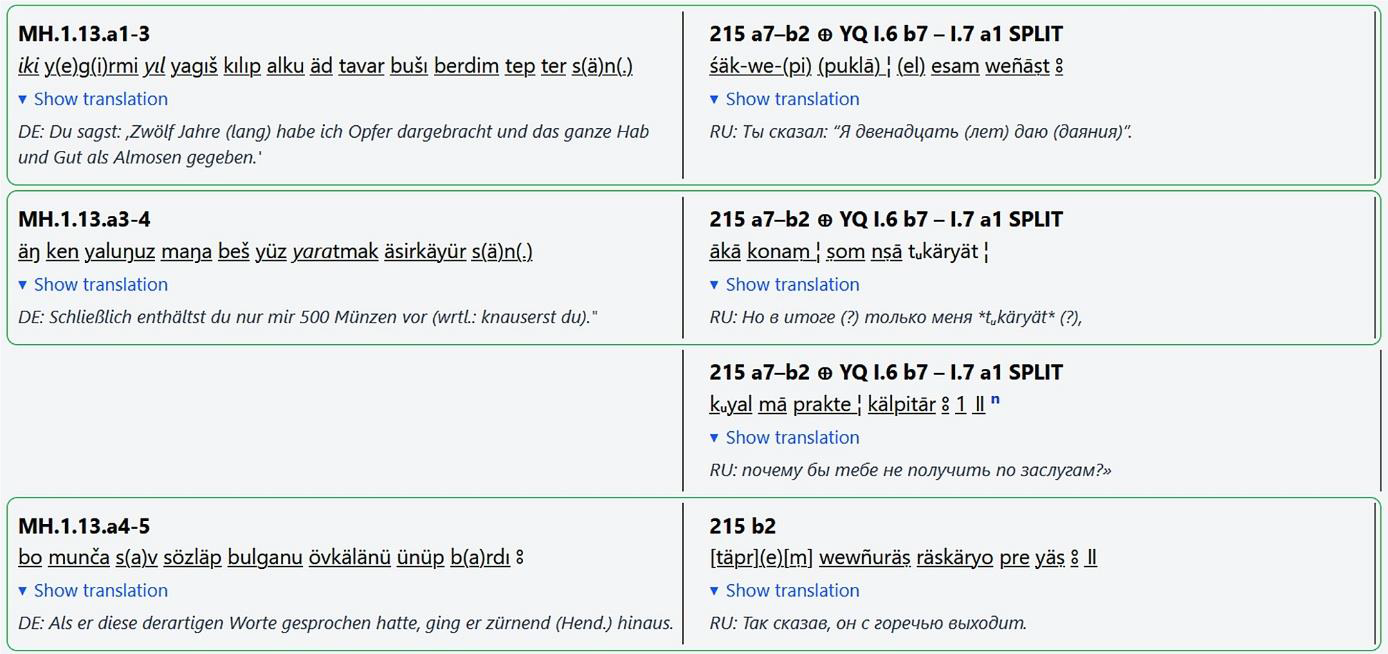
В статье представлен 4TB – онлайн-корпус, разработанный для исследования тохарского A и древнеуйгурского языков. Его цель – собрать и выровнять тохарские А фрагменты с их древнеуйгурскими (а в дальнейшем и санскритскими) параллелями, прежде всего тохарский Maitreyasamiti-Nāṭaka и его древнеуйгурский перевод Maitrisimit nom bitig. Несмотря на обширную исследовательскую традицию, полные издания этих текстов до сих пор не опубликованы. В настоящее время готовится редакция тохарской версии, которая послужит основой для корпуса, тогда как 4TB сосредоточен на сборе древнеуйгурских параллельных фрагментов как основе для полного издания Maitrisimit nom bitig в будущем. По сравнению с существующими цифровыми ресурсами тохарские тексты представлены относительно полно, тогда как корпусы древнетюркских текстов остаются неполными, что делает даже частичный параллельный корпус значимым вкладом. В статье рассматриваются ключевые проблемы проектирования и разработки корпуса. Транслитерация для обоих языков не используется, тогда как транскрипция реализована по-разному. Для тохарского A она следует устоявшимся конвенциям, тогда как для древнеуйгурского все данные нормализованы в рамках единой системы транскрипции с исправлением некоторых устаревших форм. Дополнительные трудности связаны с неоднородностью транскрипционных систем в научной литературе. Переводы приводятся в соответствии с языками исходных публикаций (русский для тохарского A, преимущественно немецкий для древнеуйгурского), планируется добавление автоматического английского перевода. Корпус структурирован вокруг токенов как минимальных единиц, однако выравнивание фрагментов осуществляется на более высоком уровне из-за отсутствия надежного пословного соответствия. В связи с проблематичностью сегментации по предложениям вводится более гибкая единица – «пассаж». Пассажи объединяются в «группы пассажей» для учета различий между манускриптами и затем выравниваются между языками, допуская расхождения, такие, как пропуски и добавления. Такой подход сохраняет связность текста и отличается от стандартных корпусных моделей, основанных на формате KWIC. Корпус включает ряд основных функций. Словари охватывают все лемматизированные токены и связывают формы и написания с грамматической разметкой. Конкорданс отображает пассажи вместе с их параллелями. Поисковые инструменты поддерживают запросы по написанию, форме, лемме и грамматическим признакам (последнее включает межъязыковой поиск). Инструменты редактирования позволяют изменять тексты и лексические данные, включая полуавтоматическую лемматизацию, и имеют потенциал для дальнейшего развития. В целом 4TB представляет собой масштабируемую платформу, которая может быть использована в будущих корпусных проектах. Он способствует межъязыковым исследованиям тохарских и тюркских языков и расширяет доступ к материалу для нелингвистов, включая буддологов.
Скачивания
Литература
Bonelli E.T., 2010. Theoretical overview of the evolution of corpus linguistics. The Routledge Handbook of Corpus Linguistics. Editors: Anne O’Keeffe and Michael McCarthy. 1st ed. p. cm. (Routledge handbooks in applied linguistics). P. 14–28.
Burlak S.A., Itkin I.B., 2004. Tokharskij tekst A 446: yeshchë odna rukopis’ tokharskoy versii Maitreyasamiti-Nāṭaka. [Tocharian Text A 446: Another manuscript of the Tocharian version of the Maitreyasamiti-Nāṭaka] Voprosy Jazykoznanija. 3. P. 24–35). [in Russian].
Burlak S.A., Itkin I.B., 2013. Tokharskie yazyki [Tocharian languages]. Yazyki mira. Reliktovye indoevropeyskie yazyki Peredney i Tsentral’noy Azii. Red. koll.: Yu.B. Koryakov, A.A. Kibrik [Languages of the world: relict Indo-European languages of Western and Central Asia. Editorial Board: Yu.B. Koryakov, A.A. Kibrik]. Moscow: Academia. P. 386–485. [in Russian].
Geng Sh., Laut J.-P., Pinault G.-J., 2004a. Neue Ergebnisse der Maitrisimit-Forschung. Zeitschrift der Deutschen Morgenländischen Gesellschaft [New results of Maitrisimit research. Journal of the German Oriental Society]. 154. P. 347–369. [in German].
Geng Sh., Laut J.-P., Pinault G.-J., 2004b. Neue Ergebnisse der Maitrisimit-Forschung (II): Struktur und Inhalt des 26. Kapitels [New Results of Maitrisimit Research (II): Structure and content of chapter 26]. Studies on the Inner Asian Languages. 19. P. 29–94 + Plates III–XIII. [in German].
Erdal M., 2004. A Grammar of Old Turkic. Vol. Central Asia 3. Handbook of Oriental Studies 8. Leiden: Brill. 575 p.
Erdal M., Gippert J., Röhrborn K., Zieme P., Nevskaya I., Knüppel M., Özertural Z., Taube J., 2003. Vorislamische Alttürkische Texte: Elektronisches Corpus [Pre-Islamic Old Turkic texts: Electronic corpus]. [Electronic resource]. Available at: https://vatec2.fkidg1.uni-frankfurt.de/ (Accessed: 29.03.2026). [in German].
Derin M.O., Harada T., 2021. Universal Dependencies for Old Turkish. In Proceedings of the Fifth Workshop on Universal Dependencies (UDW, Syntax Fest 2021). Sofia, Bulgaria. Association for Computational Linguistics. P. 129–141.
Itkin I.B., Kuritsyna A.V., Malyshev S.V., 2017. Tocharian A text THT 1331 and the “Höllenkapitel” of the “Maitrisimit nom bitig”: some more remarks. Tocharian and Indo-European studies. 18. P. 71–81.
Itkin I.B., Kuritsyna A.V., Wilkens J., Nugteren H., 2025. THT-fragments of Maitreyasamiti-Nāṭaka: Current state of the topic and some new identifications. Acta Orientalia Academiae Scientiarum Hungaricae. 1 (78). P. 85–113.
Lefer M.-A., 2020. Parallel Corpora. Magali Paquot, Stefan Th. Gries (eds.). A Practical Handbook of Corpus Linguistics. Springer. P. 257–282.
Kenning M.-M., 2010. What are parallel and comparable corpora and how can we use them? The Routledge Handbook of Corpus Linguistics. Editors: Anne O’Keeffe and Michael McCarthy. 1st ed. p. cm. (Routledge handbooks in applied linguistics). P. 487–500.
Malzahn M., Braun M., Fellner H.A., Koller B., 2011. A Comprehensive Edition of Tocharian Manuscripts. [Electronic resource]. Available at: https://cetom.univie.ac.at/ (Accessed: 29.03.2026).
Müller F.W.K., Sieg E., 1916. Maitrisimit und ‘Tocharisch’ [Maitrisimit and ‘Tocharian’]. Sitzungsberichte der Königlich Preußischen Akademie der Wissenschaften [Proceedings of the Royal Prussian Academy of Sciences]. P. 395–417. [in German].
Peyrot M., Semet A., 2016. A comparative study of the beginning of the 11th act of the Tocharian A Maitreyasamitināṭaka and the Old Uyghur Maitrisimit. Acta Orientalia Hungarica. 69. P. 355–78.
Pinault G.-J., 1999. Restitution du Maitreyasamiti-Nāṭaka en tokharien A: Bilan provisoire et recherches complémentaires sur l’acte XXVI [Restoration of the Maitreyasamiti-Nāṭaka in Tocharian A: Provisional assessment and additional research on act XXVI]. Tocharian and Indo-European Studies. 8. P. 189–240. [in French].
Semet A., Äysa A., 2014. Prophezeiung über die Maitreya-Geburt. Neues zum 11. Kapitel der uighurischen Maitrisimit nom bitig [Prophecy of the birth of Maitreya: New findings on chapter 11 of the Uyghur Maitrisimit nom bitig]. Aysima Mirsultan. Mihriban Tursun Aydın. Erhan Aydın (Hrsg.): Eski Türkçeden Çağdaş Uygurcaya. Mirsultan Osman’ın Doğumunun 85. Yılına Armağan. Konya. P. 221–249. [in German].
Tekin Ş., 1980. Maitrisimit nom bitig. Die uigurische Übersetzung eines Werkes der buddhistischen Vaibhāṣika-Schule. 1. Teil: Transliteration, Übersetzung, Anmerkungen. [Maitrisimit nom bitig. The Uyghur translation of a work of the Buddhist Vaibhāṣika school. Part 1: Transliteration, translation, notes.] Schriften zur Geschichte und Kultur des Alten Orients, Berliner Turfantexte [Writings on the history and culture of the Ancient Orient, Berlin Turfan Texts]. IX. Berlin: Akademie-Verlag. 264 p. [in German].
Weisser M., 2022. What corpora are available? Anne O’Keeffe and Michael McCarthy (Eds.). The Routledge Handbook of Corpus Linguistics. Second edition. Routledge. P. 89–102.
Wilkens J., 2008. Maitrisimit und Maitreyasamitināṭaka. Aspects of research into Central Asian Buddhism. In memoriam Kōgi Kudara. Edited by Peter Zieme. Silk Road Studies 16. Turnhout: Brepols. P. 407–433.
Wilkens J., 2021. Handwörterbuch des Altuigurischen. Altuigurisch – Deutsch – Türkisch. Herausgegeben von der Akademie der Wissenschaften zu Göttingen [Concise dictionary of Old Uyghur. Old Uyghur – German – Turkish. Published by the Göttingen Academy of Sciences]. Göttingen: Universitätsverlag. 929 p. [in German].
Wilkens J., 2023. Einige Beobachtungen zu Übersetzungstechnik der altuigurischen Maitrisimit [Some observations on the translation technique of the Old Uyghur Maitrisimit]. Journal of Old Turkic Studies. 2 (7). P. 553–571. [in German].
Wołk K., 2015. Noisy-parallel and comparable corpora filtering methodology for the extraction of bi-lingual equivalent data at sentence level. Computer Science. 2 (16). P. 169–184.
Загрузки
Опубликован
Как цитировать
Выпуск
Раздел
Лицензия
Copyright (c) 2026 M.В. Выжлаков

Это произведение доступно по лицензии Creative Commons «Attribution-NonCommercial» («Атрибуция — Некоммерческое использование») 4.0 Всемирная.