The functioning of the verb bol- in analytical constructions in legal documents of Uyghur civil acts of the 10th–14th centuries
Views: 275 / PDF downloads: 136
DOI:
https://doi.org/10.32523/2664-5157-2026-2SI-32-55Keywords:
Old Uyghur language, legal documents, verb bol-, analytical constructions, legal status, civil acts, auxiliary verb, legal discourse, semantics, historical grammarAbstract
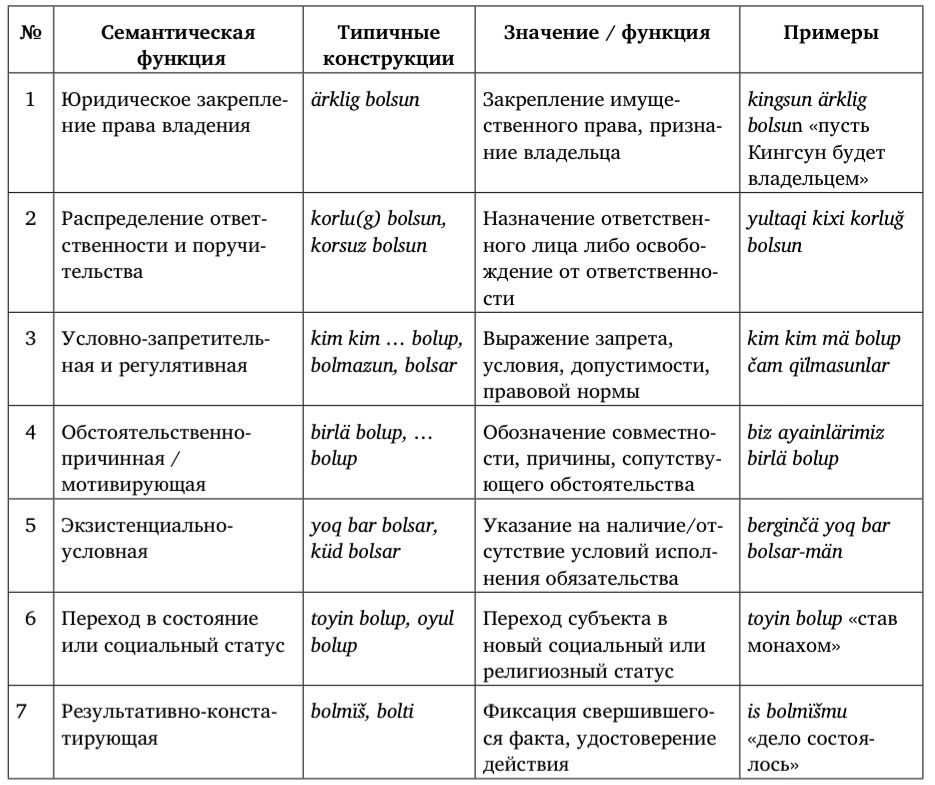
This article examines the analysis and functioning of the verb bol- within analytical constructions in legal documents based on Uyghur civil acts from the 10th to 14th centuries. The study focuses on phraseological combinations and the semantics of expressions involving the verb bol-, which plays a key role in forming legal modality, predicative relations, and standard formulas of business writing in Old Uyghur. This study aims to identify the characteristics of the verb bol- in analytical constructions within 10th–14th-century Uyghur civil acts and to determine its semantic functions in the Old Uyghur language. This study employs a methodology comprising comparative-historical, descriptive, structural-semantic, and contextual analyses. The empirical basis consists of Uyghur civil deed texts from the 10th–14th centuries, including sales contracts, promissory notes, marriage contracts, and other legal documents. This work is scientifically novel because it is the first comprehensive analysis of the verb bol- in Uyghur civil documents, identifying the peculiarities of analytical constructions in medieval Uyghur legal discourse. Previous studies did not address these aspects. The study reveals that the verb bol- is used primarily as an auxiliary verb that combines with nouns, adjectives, and participial forms in analytical constructions to create stable legal clichés. The form bolsun is the most common in legal documents. It appears in the imperative mood to express prescriptions, intentions, or normative requirements characteristic of the legal sphere during that period. Through this form, concepts such as property rights, status relations, and legal responsibility are established. Examples frequently found in legal documents include ‘ägkligbolsun’, which denotes ownership; ‘korsuzbolsun’, which denotes exemption from liability; and ‘korlubolsun’, which denotes the imposition of responsibility. These constructions define the rights and obligations of the parties in agreements. The semantic field of the verb bol- expands significantly in the examples presented, encompassing dozens of meanings. While its primary meanings are "to be" and "to become," bol- acquires a modal-legal nuance, conveying meanings of obligation, permission, conditionality, or prohibition. In combination with nominal components, bol- forms predicative constructions that ensure clarity and unambiguity in legal formulations. These constructions contribute to standardizing document language and establishing stable legal terminology.
Downloads
Reference
Ablikim Yasin, 2001. Issledovanie yazykovoj struktury svetskih dokumentov na ujgurskom pis'me iz Turfana [Research on the language structure of secular documents in Uyghur script from Turpan]. Urumchi: Sin'czyanskij universitet. 176 p. [in Russian].
Ahat Ablimit, 1989. Qädimki uyghur tili lughiti [Dictionary of the Old Uyghur language]. Urumchi: Shinjan yaşlar-ösmürlär näşriyati. 548 p. [in Uyghur].
Iskhakov G.M., Litvinskiy B.A., Sherkova T.A. et al., 1991. Kratkaya istoriya uygurov: [A Brief History of the Uyghurs]. Alma-Ata: Gylym. 254 p. [in Russian].
Litvinskiy B.A. (ed.), 1992. Vostochnyy Turkestan v drevnosti i rannem srednevekov’e: etnos, yazyki, religii: [Eastern Turkestan in Antiquity and the Early Middle Ages: Ethnos, Languages, Religions]. Moscow: Nauka. 688 p. [in Russian].
Malov S.E., 1951. Pamyatniki drevletyurkskoj pis'mennosti: teksty i issledovaniya [Monuments of ancient Turkic writing: texts and research]. Moskva; Leningrad: Izd-vo AN SSSR. 451 p. [in Russian].
Nadelyaev V.M., Nasilov D.M., Tenishev E.R., Shcherbak A.M., 1969. Drevnetyurkskiy slovar’: [Old Turkic Dictionary]. Leningrad: Nauka. 677 p. [in Russian].
Tugusheva L.Yu., 1975. Yazyk delovyh dokumentov kak funkcional'no-lingvisticheskaya raznovidnost' literaturno-pis'mennogo yazyka v drevneujgurskom obshchestve [The language of business documents as a functional-linguistic variety of the literary written language in ancient Uyghur society]. Pis'mennye pamyatniki i problemy istorii kul'tury narodov Vostoka [Written monuments and problems of the history of culture of the peoples of the East]. P. 70–73. [in Russian].
Tenishev E.R. (ed.), 1997. Yazyki mira. Tyurkskie yazyki: [Languages of the World. Turkic Languages]. Bishkek: Kyrgyzstan. 543 p. [in Russian].
Tugusheva L.Yu., 2013. Ujgurskie delovye dokumenty X–XIV vv. iz Vostochnogo Turkestana [Uyghur business documents of the 10th–14th centuries from East Turkestan]. Moskva: Vostochnaya literatura. 328 p. [in Russian].
Arat R. Rahmeti, 1964. Eski Türk Hukuk Vesikaları [Old Turkish Legal Documents]. Türk Kültürü Araştırmaları. 1(1). P. 1–53. [in Turkish].
Caferoğlu A., 1993. Eski Uygur Sözlüğü [Old Uyghur Dictionary]. İstanbul: Endurum Kitabevi. 210 p. [in Turkish].
Eraslan K., 2023. Eski Uygur Türkçesi Grameri [Grammar of Old Uyghur Turkish]. İstanbul: Türk Dil Kurumu Yayınları. 550 p. [in Turkish].
Erdal M., 2004. A Grammar of Old Turkic. Leiden; Boston: Brill. 575 p.
Keskin B., 2019. Eski Uygur hukuk belgelerinde kısaltmalar [Abbreviations in Old Uyghur legal documents]. International Journal of Old Uyghur Studies. 1(2). P. 233–248. [in Turkish].
Korkmaz S., 2022. Uygur Hukuk Vesikaları Üzerine Türkçe Literatürün Hukuki Tahlili [Legal Analysis of Turkish Literature on Uyghur Legal Documents]. Adalet Dergisi. 69. P. 249–291. [in Turkish].
Saral R., 2023. Eski Uygur Türkçesi hukuk belgeleri üzerine değerlendirme [An evaluation of Old Uyghur Turkish legal documents]. Türk Dili ve Edebiyatı Dergisi. 63(1). P. 261–268. [in Turkish].
Sayit M., Yüsüp I., 2000. Qedimki uyghur yéziqidiki wesiqiler [Documents in the Old Uyghur script]. Ürümchi: Shinjang xelq neshriyati. 445 p. [in Uyghur].
Şen S., 2017. Eski Uygur Türkçesi dersleri [Old Uyghur Turkish lessons]. 3. baskı. İstanbul: Kesit Yayınları. 303 p. [in Turkish].
Wilkens J., 2021. Handwörterbuch des Altuigurischen [Handy Dictionary of Old Uyghur]. Göttingen: Universitätsverlag Göttingen. 929 p. [in German].
耿世民 (Geng Shimin), 2006. Huihuwen shehui jingji wenshu yanjiu [Research on Old Uyghur Socio-Economic Documents]. Beijing: Central Nationalities University Press. 327 p. [in Chinese].
Downloads
Published
How to Cite
Issue
Section
License
Copyright (c) 2026 А.А. Авалиев, Р.А. Авакова, Е. Баят

This work is licensed under a Creative Commons Attribution-NonCommercial 4.0 International License.