Functional and semantic aspects of the verb pol- in the Khakass language
Views: 0 / PDF downloads: 0
DOI:
https://doi.org/10.32523/2664-5157-2026-3-99-120Keywords:
Khakas language, verb pol-, existence, semantics, syntactic functions, predicativity, modality, grammaticalization, analytical constructions, aspectuality, existential meanings, Turkic languagesAbstract
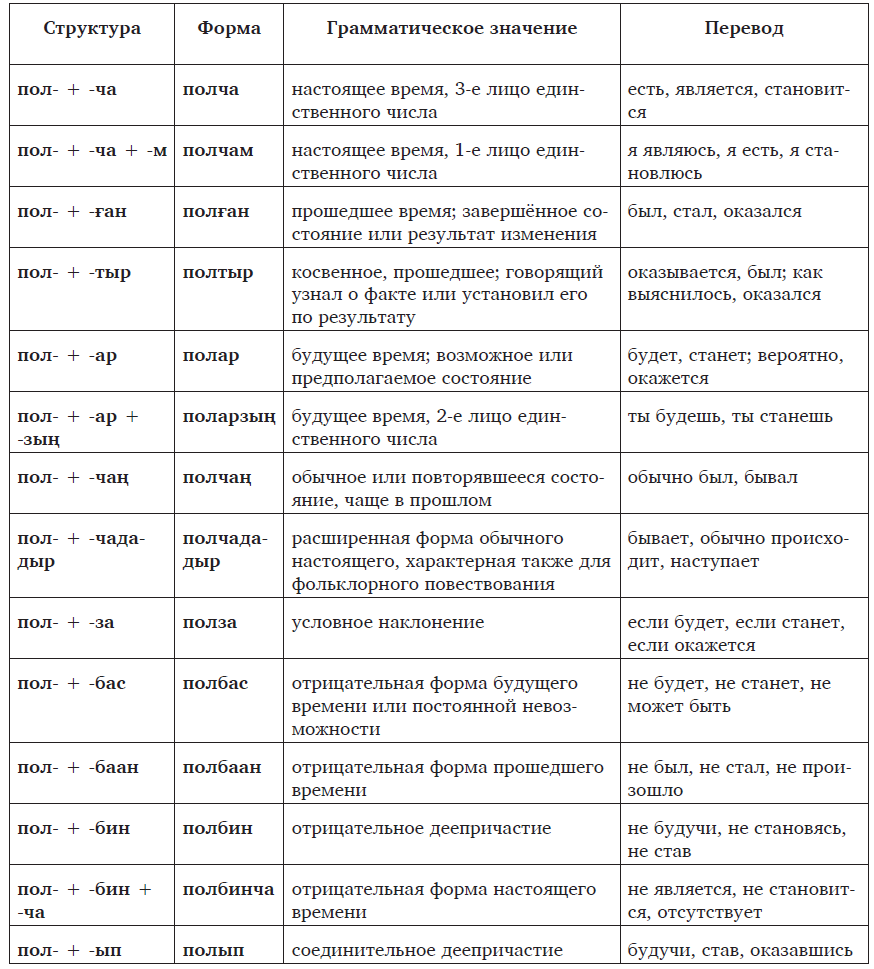
This article examines the functional semantics of the verb pol- in Khakass. The verb is characterized by a high degree of functional and semantic productivity, functioning both as a full lexical verb and as a component of analytical predicates. The aim of the study is to identify the meanings and functions of pol- and to describe the processes underlying its grammaticalization within the grammatical system of Khakass. The study is based on material drawn from literary, academic, and Khakass-language texts representing various types of usage of the unit under investigation. The analysis employs descriptive, comparative, structural, and contextual methods. Particular attention is paid to the meanings of pol- associated with being, becoming, existence, occurrence, and completion, as well as to the ways in which these meanings are realized in different contexts. Special emphasis is placed on constructions in which pol- functions as an auxiliary verb and participates in the expression of tense, aspectual, and modal meanings. Depending on the construction, pol- may participate in the formation of present, past, perfect, future, and conditional-hypothetical forms. Its role in negative and interrogative constructions is also examined separately, as pol- contributes to the formation of the semantic and grammatical structure of the utterance. The study establishes that the functional development of the verb pol- reflects a gradual transition from its use as a full lexical verb to its grammaticalization as a component of analytical constructions. At the same time, pol- retains a semantic connection with its lexical meaning, particularly in the expression of states, processes of becoming, completion, and resultant states. The interaction between the lexical and grammatical functions of pol- makes it possible to regard the verb as one of the important elements of the verbal system of Khakass. A comparison with other Turkic languages demonstrates that the functional development of verbs expressing states, becoming, and existence represents a widespread linguistic phenomenon. However, the specific meanings and grammatical patterns in which such verbs are used are determined by the particular grammatical systems of individual languages. The findings make it possible to clarify the position of the verb pol- within the system of analytical predicates in Khakass, identify the features of its functional and grammatical structure, and determine the main stages of its functional development. The study contributes to a systematic understanding of the grammaticalization of lexical units in Khakass and provides a basis.
Downloads
Reference
Karabeyoglu, A.R., 2015. Orhon yazitlarinda bol- ve er- fiilleri uzerine [On the Verbs boland er- in the Orkhon Inscriptions]. [Electronic resource]. URL: https (accessed: 17.05.2025). [in Turkish].
Menz, A., 2015. The Conditional in South Siberian Turkic. [Electronic resource]. URL: https://www.researchgate.net/publication/280875509_The_conditional_in_South_Siberian_Turkic (accessed: 27.08.2025). [in English].
Borgoyakova, M.P., Maynagasheva, N.S., Tishkova, V.S., Borgoyakova, D.M., Mamysheva, N.A., Tolmashova, N.A., Topoev, R.P., 2014. Hakas literaturazy 7 klass: uchebnik dlya obshcheobrazovatelnyh organizacij [Khakass Literature. Grade 7: Textbook for General Education Organizations]. Abakan: Hakasskoe knizhnoe izdatelstvo. 182 p. [in Khakass].
Borgoyakova, M.P., Maynagasheva, N.S., Tishkova, V.S., Borgoyakova, D.M., Mamysheva, N.A., Tolmashova, N.A., Topoev, R.P., 2014. Hakas literaturazy 9 klass: uchebnik dlya obshcheobrazovatelnyh organizacij [Khakass Literature. Grade 9: Textbook for General Education Organizations]. Abakan: Hakasskoe knizhnoe izdatelstvo. 248 p. [in Khakass].
Dobrov, M.K., 1958. Altyn Chus: chaalyg nymah [Altyn Chus: Heroic Tale]. Abakan: Hakasskoe knizhnoe izdatelstvo. 96 p. [in Khakass].
Drevnetyurkskij slovar, 1969 [Old Turkic Dictionary]. Leningrad: Nauka. 676 p. [in Russian].
Domozhakov, V.I., Chankov, D.I., 1951. Geroicheskie skazaniya = Alyptyg nymaltar [Heroic Tales]. Abakan: Hakasskoe oblastnoe gosudarstvennoe izdatelstvo. 320 p. [in Khakass].
Dyrenkova, N.P., 1948. Grammatika hakasskogo yazyka: fonetika, morfologiya [Grammar of the Khakass Language: Phonetics, Morphology]. Abakan: Hakasskoe oblastnoe nacionalnoe izdatelstvo. 122 p. [in Russian].
Karpov, V.G., 2014. Izjavitel’noe naklonenie glagola v sovremennom hakasskom jazyke [Indicative Mood of the Verb in Modern Khakass Language]. Abakan: Izdatel’stvo FGBOU VPO «Hakasskij gosudarstvennyj universitet im. N. F. Katanova». 164 p. [in Russian].
Kormushin, I.V., 1984. Sistema vremyon glagola v altajskom yazyke [The System of Verb Tenses in the Altai Language]. M.: Nauka. 85 p. [in Russian].
Kuberzkikova A.B., Torokova E.S. Korbelet, 2020. Sbornik statej [Collection of Articles]. Abakan: OOO «IPP Zhurnalist». 120 p. [in Russian].
Nasilov, D.M., 1976. K istorii vspomogatelnyh glagolov v tyurkskih yazykah [On the History of Auxiliary Verbs in the Turkic Languages]. Tyurkologicheskie issledovaniya [Turkological Studies]. M. Pp. 158–168. [in Russian].
Oorzhak, B.Ch., 1997. Sistema grammaticheskoj modalnosti v tuvinskom yazyke (v sopostavlenii s tyurkskimi yazykami Sibiri) [The System of Grammatical Modality in the Tuvan Language (in Comparison with the Turkic Languages of Siberia)]. Novosibirsk: Nauka. 517 p. [in Russian].
Tenishev, E.R. (ed.), 2002. Sravnitelno-istoricheskaya grammatika tyurkskih yazykov. Morfologiya [Comparative-Historical Grammar of the Turkic Languages. Morphology]. M.: Nauka. 767 p. [in Russian].
Todanov, P.V., 1977. Hara Husfun: geroicheskoe skazanie = Hara Husfun: alyptyg nymah [Hara Husfun: Heroic Tale]. Abakan: Krasnoyarskoe knizhnoe izdatelstvo, Hakasskoe otdelenie. 195 p. [in Russian].
Chebodaeva, L.I., Karachakova, E.G., Sultrekova, Z.I., Tahtarakova, M.L., Tolmashova, N.A., 2014. Hakas literaturyzy 6-klass [Khakass Literature. Grade 6]. Abakan: Hakas kitap izdatelstv. 200 p. [in Khakass].
Shamina, L.A., 1988. Zavisimoe skazuemoe s formami glagola bol- v roli vtorogo komponenta predlozheniya [Dependent Predicate with Forms of the Verb bol- as the Second Component of the Sentence]. Komponenty predlozheniya [Sentence Components]. Novosibirsk. Pp. 143–153. [in Russian].
Shulbaeva, S., 2007. Han na belobulanom kone [akh Khan on the Buckskin Horse]. Abakan: Hakasskoe knizhnoe izdatelstvo. 276 p. [in Khakass].
Shcherbak, A.M., 1981. Ocherki po sravnitelnoj morfologii tyurkskih yazykov (glagol) [Essays on the Comparative Morphology of the Turkic Languages (Verb)]. L.: Nauka. 224 p. [in Russian].
Yuldashev, A.A., 1965. Analiticheskie formy glagola v tyurkskih yazykah [Analytical Forms of the Verb in the Turkic Languages]. M.: Nauka. 274 p. [in Russian].
Downloads
Published
How to Cite
Issue
Section
License
Copyright (c) 2026 Р.А. Авакова, Д. Кулмаматов, А.А. Авалиев

This work is licensed under a Creative Commons Attribution-NonCommercial 4.0 International License.