Food vocabulary in the Medieval written monument “Tardjuman” (14th Century) (Based on the material of “Kitāb-i maǧmūʿ-i tarǧumān-i turkī wa ʿaǧamī wa muġālī wa fārsī”)
Views: 119 / PDF downloads: 41
DOI:
https://doi.org/10.32523/2664-5157-2026-3-139-160Keywords:
food-related vocabulary, “Tardjuman”, Mamluks, cultural lacunae, translation strategy, explication, historical-comparative analysis, semantics, food, beverages, dairy productsAbstract
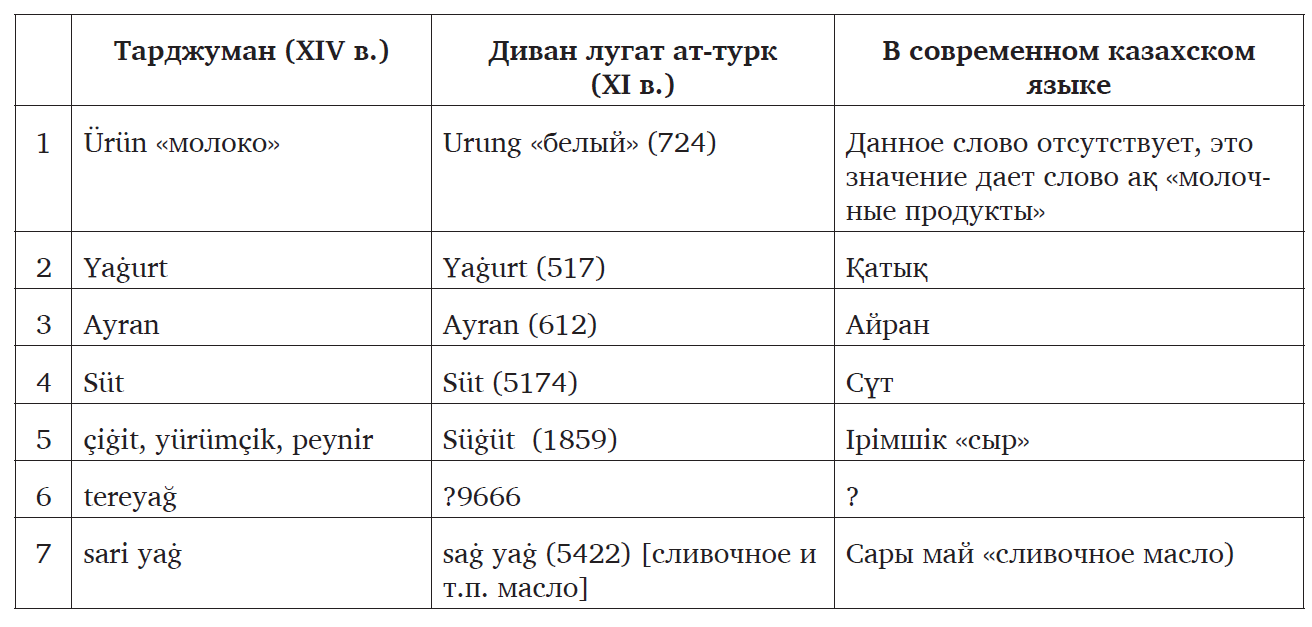
This article examines food-related vocabulary in the fourteenth-century Arabic-Turkic dictionary Kitāb-i Maǧmūʿ-i Tarǧumān-i Turkī wa ʿAǧamī wa Muġālī wa Fārisī (“Tardjuman”), considering it as a source for reconstructing the linguistic and cultural worldview of the Turkic Mamluks. The relevance of the study lies in the need for a comprehensive investigation of food vocabulary as a culturally significant component of language that reflects economic organization, social structure, religious beliefs, and intercultural interactions. The study aims to identify the semantic, structural, and sociocultural characteristics of foodrelated vocabulary and to determine its role in representing the dietary practices of Mamluk society. The research is based on the thirteenth thematic section of the dictionary, which is devoted to food, beverages, and dairy products. The methodological framework combines historical, comparative, semantic, etymological, and cultural-historical approaches. Drawing on data from Mahmud al-Kashgari’s Dīwān Luġāt at-Turk and the modern Kazakh language, the study traces historical continuity and semantic evolution and assesses the degree to which Turkic food-related vocabulary has been preserved. The analysis also incorporates findings from historical and cultural studies of Mamluk society. An interdisciplinary approach integrating historical linguistics, ethnolinguistics, and cultural anthropology is employed. Particular attention is paid to the strategies used by the dictionary's compiler to convey culturally specific information and bridge the cultural gap between Turkic and Arabic societies. The findings demonstrate that the food vocabulary of the Tardjuman reflects the nomadic economic system and meat-and-dairy dietary model of the Turkic Kipchaks. The most representative lexical groups are the names of meat and dairy products, many of which have been preserved in modern Kazakh, indicating a high degree of continuity in Turkic food culture. The dictionary's compiler actively employs extended descriptions and comparisons to convey realia that were unfamiliar or absent in Arabic culture. This translation strategy can therefore be interpreted as a means of overcoming cultural lacunae. Particular attention is also given to the vocabulary of alcoholic beverages, which reflects the specific characteristics of cultural interaction within Mamluk society. Food vocabulary serves not only a nominative function but also a sociocultural and symbolic one, functioning as a marker of power, social status, and ethnocultural identity. The study demonstrates that medieval bilingual dictionaries constitute valuable sources for reconstructing the history and culture of Turkic peoples. The analysis further indicates a high degree of stability in food-related vocabulary, with approximately 80% of the identified lexical units preserved in modern Kazakh. This continuity points to the deep historical rootedness of the meat-and-dairy dietary model in Turkic culture. Overall, the findings contribute to a better understanding of the linguistic and cultural heritage of the Turkic Mamluks and demonstrate the value of historical lexicographic sources for tracing the continuity and transformation of Turkic vocabulary.
Downloads
Reference
Garkavec A.N., 2019. Kitab-i Madzhmuʽ-i Tardzhuman-i Turki va ʽAdzhami va Mugali va Farsi («Svodnaya kniga perevodchika…») Halila bin Muhammada bin Jusufa al-Kunavi (pri uchastii O.O. Tuyakbaeva) [The Book of the Compendium of the Interpreter in Turkic, Persian, Mongolian, and Arabic (“The Comprehensive Book of the Interpreter…”) by Khalil ibn Muhammad ibn Yusuf al-Qunawi (with the participation of O. O. Tuyakbaev)]. Almaty: Baur. 600 p. [in Russian].
Zhilkubaeva A.Sh., 2013. Leksika pitaniya v tyurkskikh yazykakh lingvokul’turologicheskiy aspekt) [Food Vocabulary in Turkic Languages (A Linguocultural Perspective)]. Ust-Kamenogorsk: Izd-vo VKGU im. S. Amanzholova. 292 p. [in Russian].
Jubatova B., Aubakirova Q., 2019. Mysyrdagy mamlukter bilіgі tusundagy turkі-arab madenitіldіk bajlanystary (XIII–XV ғ.) [Turkic–Arabic Cultural and Linguistic Relations during the Mamluk Rule in Egypt (13th–15th Centuries)]. Almaty: Qazaq universitetі. 235 p. [in Kazakh].
Mahmud al-Kashgari, 2024. Divan lugat at-Turk (per. i predisl. Z.-A. Auezovoj; indeksy sost. R. Ermersom) [Dīwān Lughāt al-Turk (translated and introduced by Z.-A. Auezova; indexes compiled by R. Ermers)]. Baku: Zәrdabi naşr MMC. 1376 p. [in Russian]
Ragıp М., & Torebekova С., 2022. Mamluk-qypshaq eskertkіshterіndegі arab tіlіne engen turkі sozderі [Turkic borrowings in the Arabic language of the Mamluk-Kipchak written monuments]. Turkic Studies Journal, 3(4). P. 52–60. https://doi.org/10.32523/2664-5157-2021-4-52-60 [in Kazakh].
Sabyr M..B., Ramanova A.A., Kussainova D.Zh., Akhmetov T.R. Naimenovaniya produktov pitaniya v pis'mennyh pamyatnikah srednevekov'ya i ih lingvokul'turnoe pole v kazahskom yazyke [Names of food roducts in written monuments of the middle ages and their linguocultural field in the Kazakh language]. QazHQTU jäne ÄTU Habarşysy. Filologiya ğılymdary seriyasy. Vol. 75. № 4 (2024). P. 213-226 [in Russian].
Syzdyq R., 2004. Sözder söyleydi [Words Speak]. Almaty: Arys. 232 p. [in Kazakh].
Berkey J., 2009. Mamluk Religious Policy. Mamlūk Studies Review.Vol. XIII. No. 2. P. 7-23 http://mamluk.uchicago.edu/MamlukStudiesReview_XIII-2_2009.pdf
Dahmaan M.A., 1990. Mu’jam al-alfaaz at-ta’rikhiyya fi Misr al-Mamluki [A Dictionary of Historical Terms in Mamluk Egypt]. Dimashq: Daar al-Fikr al-Mu’asir. 158 p. [in Arabic].
Gerhardt C., 2013. Food and language – language and food. In: Gerhardt C., Frobenius M., Ley S. (eds.) Culinary Lingui stics: The Chef’s Special. Amsterdam; Philadelphia: John Benjamins Publishing Company. P. 3–50.
Khallaq Khasan, Sebagh Abbas, 1999. Al-Mu’jaam al-Jaami’ fi mustallakhaat al-Ayyubiyya wa al-Mamlukiyya wa al-‘usmaniyya zat al-usul al-‘arabiyyati waal-Farisiyyati wa at-Turkiyyati [The Comprehensive Dictionary of Terms of the Ayyubid, Mamluk, and Ottoman Periods of Arabic, Persian, and Turkish Origin]. Beyrut: Dar al-‘elm lilmalayin. 246 p. [in Arabic]
Levanoni A., 2005. Food and Cooking during the Mamluk Era: Social and Political Implications. Mamlūk Studies Review. Vol. 9. No. 2. P. 1–20.
Lewicka P., 2011. Food and Foodways of Medieval Cairenes: Aspects of Life in an Islamic Metropolis of the Eastern Mediterranean. Leiden: Brill. 600 p.
Limor Y., 2017. Medieval Middle Eastern Court Taste: The Mamluk Case. Developing Perspectives in Mamluk History. Leiden: Brill. P. 76–96.
Yıldırım K. D., Özyetgin M., 2019. Memlûk-Kıpçak Türkçesinde kurutulmuş ve saklanmış gıda maddeleri [Dried and stored food items in Mamluk-Kipchak Turkish]. ASOS Journal. №7 (95). С. 372-385. DOI http://dx.doi.org/10.16992/ASOS.15107 [in Turkish].
Downloads
Published
How to Cite
Issue
Section
License
Copyright (c) 2026 B. Jubatova

This work is licensed under a Creative Commons Attribution-NonCommercial 4.0 International License.