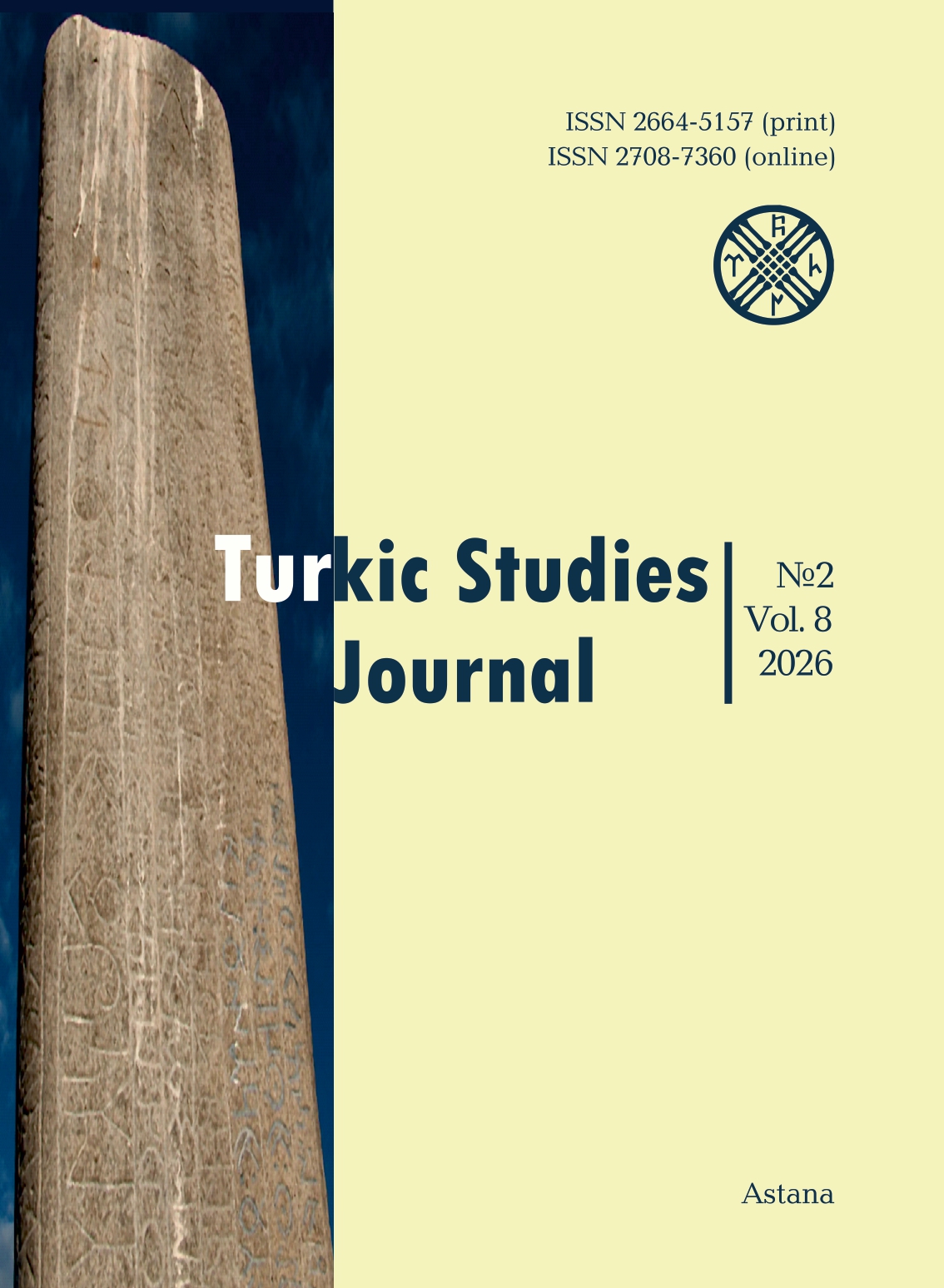
The linguistic nature of folk geographical terms in the Kazakh and Nogai languages
Views: 252 / PDF downloads: 78
DOI:
https://doi.org/10.32523/2664-5157-2026-2-228-247Keywords:
Kazakh language, Nogai language, folk geographical terms, linguogeography, etymology, fossilized roots, morphological structure, lexico-semantic system, historicalcomparative method, linguistic worldviewAbstract
The Kazakhs and Nogais are historically related peoples, which explains the typological and genetic similarities between their languages. The ethnogenetic and culturalhistorical unity of these peoples has contributed to the preservation of substantial shared linguistic elements and archaic lexical units. Their nomadic lifestyle and economic activities, which were adapted to constant movement according to climatic conditions, fostered a profound understanding of their surroundings and natural phenomena. The precise differentiation of steppe expanses, landforms, water sources, and vegetation cover was vital. Natural objects were given common names based on shared characteristics, leading to the formation of a rich inventory of folk geographical terms and an integral linguogeographical system. These names were passed down through the generations, becoming firmly established in collective memory and linguistic tradition. On the one hand, folk terms serve as evidence of geographical cognition, and on the other hand, they reflect the linguistic worldview and background knowledge of nature. These terms represent the natural and landscape features of specific territories and embody the traditional experience and worldview of the people. This article analyzes the formation conditions and linguistic nature of folk geographical terms in the Kazakh and Nogai languages. The research employs historical-comparative, descriptive, and etymological methods to ensure a systematic examination of the linguistic material. Perception of the environment is realized through identification of each object type and assignment of an appropriate designation. While these names are preserved in language, the mechanisms by which they are formed, their original meanings, and the reasons behind them are not always clear. Therefore, etymological studies were conducted on a number of obscure folk terms. The analysis proposed hypotheses about the shared origin of words such as quray, qurğaq, and qurlyq; küdir, küp, köbe (zher kobesi), and köbek, which all stem from the same underlying base. A comparative analysis of words with similar meanings and phonetically related forms revealed that their proto-roots date back to the variants qu, qü, kü, and kö. These variants function as fossilized roots in modern language. A word's morphological structure reflects its origin and the evolution of its semantic development, as manifested by the expansion and differentiation of meanings. This study establishes that the morphological structure of these terms includes root, derived, and compound forms, and that their equivalents in both languages are formed by identical methods. Furthermore, the study shows that these terms share motivational bases and lexico-semantic systems, which testifies to their historical unity and deep linguistic interrelation.
Downloads
Reference
Aqtobe gazeti, 2022. [Aktobe newspaper]. [Electronic resource]. Available at: https://aqtobegazeti.kz/?p=108487 (Accessed: 08.12.2025). [in Kazakh].
Apresyan Yu.D., 1995. Izbrannye trudy. T. 2. Integralnoe opisanie yazyka i sistemnaya leksikografiya [Selected works. Vol. 2. Integral description of language and systemic lexicography]. Moscow: Yazyki russkoy kultury. 769 p. [in Russian].
Biyarov B., 2012. Zher-su attarynyn sozzhasamdyk ulgileri [Word-formation patterns of place names]. Almaty: Memlekettik tildi damytu instituty. 460 p. [in Kazakh].
Bulgarova M., 1999. Nogajskaya toponimiya [Nogai toponymy]. Stavropol: Stavropolservisshkola. 320 p. [in Russian].
Gumboldt V. fon, 1984. Izbrannye trudy po yazykoznaniyu [Selected works on linguistics]. Moscow: Progress. 400 p. [in Russian].
Drevnetyurkskiy slovar, 1969. [Old Turkic dictionary]. Leningrad: Nauka. 677 p. [in Russian].
Zhanuzakov T., 2015. Halyqtyq geografiyalyq terminder [Folk geographical terms]. Almaty. 320 p. [in Kazakh].
Zher-su ataularynyn anyqtamalygy, 2009. [Dictionary of place names]. Almaty: Arys. 568 p. [in Kazakh].
Kaidar A., 2005. Struktura odnoslozhnyh kornej i osnov v kazahskom yazyke [Structure of monosyllabic roots and stems in the Kazakh language]. Almaty: Arys. 304 p. [in Russian].
Krylov G.A., 2026. Etimologicheskiy onlayn-slovar russkogo yazyka [Etymological online dictionary of the Russian language]. [Electronic resource]. Available at: https://lexicography.online/etymology/krylov/ (Accessed: 11.12.2025). [in Russian].
Qayyrzhan K., 2013. Soz-sandyq: Qazaqtyn kone sozderi [Lexical treasury: ancient Kazakh words]. Almaty: Oner. 480 p. [in Kazakh].
Qazaq adebi tilinin sozdigi, 2011. On bes tomdyq. 1-tom [Dictionary of the Kazakh literary language. Vol. 1]. Almaty: Dauir. 752 p. [in Kazakh].
Qazaq adebi tilinin sozdigi, 2011. On bes tomdyq. 8-tom [Dictionary of the Kazakh literary language. Vol. 8]. Almaty. 744 p. [in Kazakh].
Qazaq adebi tilinin sozdigi, 2011. On bes tomdyq. 10-tom [Dictionary of the Kazakh literary language. Vol. 10]. Almaty: Dauir. 752 p. [in Kazakh].
Qazaq adebi tilinin sozdigi, 2011. On bes tomdyq. 12-tom [Dictionary of the Kazakh literary language. Vol. 12]. Almaty: Dauir. 752 p. [in Kazakh].
Qazaq tilinin aimaqtyq sozdigi [Regional dictionary of the Kazakh language], 2005. Almaty: Arys. 824 p. [in Kazakh].
Qazaq dasturli madenietinin enciklopediyalyq sozdigi [Encyclopedic dictionary of traditional Kazakh culture], 1997. Almaty: Sozdik-slovar. 368 p. [in Kazakh].
Qoishybaev E., 1985. Qazaqstannyn zher-su attary sozdigi [Dictionary of place names of Kazakhstan]. Almaty: Mektep. 256 p. [in Kazakh].
Levitskaya L.S., Dybo A.V., Rassadin V.I., 2000. Etimologicheskiy slovar tyurkskih yazykov: Obshchetyurkskie i mezhtyurkskie osnovy na bukvu «Q» [Etymological dictionary of Turkic languages]. Moscow: Nauka. 262 p. [in Russian].
Matbek N.Q., 2018. Turki tildes nogai ulty: Nogai tili [Nogai people among Turkic-speaking peoples: Nogai language]. [Electronic resource]. Available at: https://vk.com/wall-158799159_100 (Accessed: 10.12.2025). [in Kazakh].
Nikonov V.A., 2011. Vvedenie v toponimiku [Introduction to toponymy]. Moscow: LKI. 184 p. [in Russian].
Nogaisko-russkiy slovar [Nogai-Russian dictionary], 1963. Moscow: Gosudarstvennoe izdatelstvo inostrannyh i nacionalnyh slovarey. 560 p. [in Russian].
Ondasynov N.D., 1974. Parsysha-qazaqsha tusindirme sozdik [Persian-Kazakh explanatory dictionary]. Almaty: Kazakhstan. 384 p. [in Kazakh].
Podolskaya N.V., 1988. Slovar russkoy onomasticheskoy terminologii [Dictionary of Russian onomastic terminology]. Moscow: Nauka. 191 p. [in Russian].
Sharuaschylyq kitaby No24. [Economic register book]. [Electronic resource]. Available at: https://muragat-bko.gov.kz/catalog/scan/opisi/S2_11.pdf (Accessed: 10.12.2025). [in Kazakh].
Wikipedia. Zhantaq [camelthorn]. [Electronic resource]. Available at: https://kk.wikipedia.org/wiki/Жантақ (Accessed: 15.01.2026).
Wikipedia. Zhusan [wormwood]. [Electronic resource]. Available at: https://kk.wikipedia.org/wiki/Жусан (Accessed: 15.01.2026).
Wikipedia. Izen. [saltwort]. [Electronic resource]. Available at: https://kk.wikipedia.org/wiki/Изен (Accessed: 15.01.2026).
Wikipedia. Kendir [hemp]. [Electronic resource]. Available at: https://kk.wikipedia.org/wiki/Кендір (Accessed: 15.01.2026).
Falcinelli I., Fini C., Mazzuca C., Borghi A.M., 2024. The geo domain: a review on the conceptualization of geographical and geopolitical entities. Frontiers in Psychology. 15. Article 1389581. P. 1–19.
Lim S.L.T.G., Perono Cacciafoco F., 2023. Toponyms as a Gateway to Society. Journal of Ancient History and Archaeology. 10 (1).Sozdik.kz, 2026. [Electronic resource]. Available at: https://sozdik.kz/kk/dictionary/translate/kk/ru/күдір/ (Accessed: 15.01.2026).
Downloads
Published
How to Cite
Issue
Section
License
Copyright (c) 2026 Б. Абдуалиулы, А. Айнабек

This work is licensed under a Creative Commons Attribution-NonCommercial 4.0 International License.